[ARBITRUM] Revert the Delegate Incentive Program (DIP) to Version 1.5
Proposal: Roll back the changes introduced in the Delegate Incentive Program (DIP) v1.6 and v 1.7

A Call for a Fairer, More Effective, and Accountable Arbitrum DAO
Note: This proposal has been revised based on community feedback. The goal is no longer to sunset the DIP, but to restore the fair and effective framework of v1.5.
TL;DR
This proposal calls for rolling back the detrimental changes introduced in the Delegate Incentive Program (DIP) v1.6 and v1.7. We advocate for a return to the v1.5 framework, which was previously approved by an on-chain vote and established clear, objective KPIs for delegate performance.
Last update: 04/09/2025
After in-depth analysis and considering community feedback, it's clear there is strong sentiment to continue the DIP. However, the program requires significant changes.
The drop in quality and participation can be traced directly to the unsanctioned and poorly conceived changes introduced by @SEEDGov since version 1.6.
The proposal was edited to make the DIP more inclusive rather than sunsetting it.
The Core Issue
The Delegate Incentive Program (DIP) was created to encourage active and thoughtful governance participation. However, recent versions have distorted its purpose. Instead of fostering a healthy ecosystem, the changes introduced in v1.6 and v1.7 have made the program unfair, unstable, and subjective.
The program’s managers (PMs) at @SEEDGov have consistently ignored community feedback, applied rules retroactively, and created a system that penalises smaller delegates while failing to hold large, inactive ones accountable. Their proposed “fix” (v1.7) only exacerbates these problems by raising the entry barrier tenfold, cutting delegate compensation by 40%, and requesting a 25% raise for themselves.
The current version of the program is broken, its management has lost the community’s trust, and it is doing more harm than good. It’s time to restore the program that worked.
This proposal calls for a complete rollback of the DIP to the v1.5 framework.
The Problem: A System of Patronage, Not Performance
The DIP is no longer a fair system of rewards. It has become a system of patronage, where payments depend on the personal, opaque judgment of the Program Managers, not on clear, objective work.
1. The Rules Are Subjective and Unfair
The program has shifted from a predictable system to a “black box” where the PMs decide what has “quality” and “impact.”
- Guessing Games: Previously, delegates got points for explaining their vote (CR). Now, that clear rule is gone. Your explanation only gets points if the PM decides it was “impactful.” When delegate Paulo Fonseca pointed out that this was a “conceptually dangerous” metric that could reward bad behaviour, the PMs offered no clear definition, admitting it could only be judged “in hindsight.” This forces delegates to guess what the PMs want, which is not a healthy way to run a DAO.
- A “Caste System” for Delegates: The program introduced a “VP Multiplier” that punishes smaller delegates . If you have less than 4 million ARB, your score is automatically cut by up to 20%. @paulofonseca correctly called this a “sort of caste system,” and other delegates labelled it a “penalty” that makes it nearly impossible for new, hardworking delegates to get fairly compensated.
2. A Pattern of Mismanagement and Unprofessionalism
The program’s management has been marred by constant failures, making it impossible for anyone to rely on.
- Constant, Retroactive Rule Changes: The rules change almost every month. Worse, the PMs have applied major changes retroactively, in the middle of the month. As one delegate put it, it’s like “changing the rules of the game, literally in the middle of the game.”
- Late Results and Ignored Feedback: The monthly results are almost always late, and payments have taken as long as two weeks to be signed. When Paulo Fonseca repeatedly asked for proactive communication about these delays, he was met with dismissiveness. This lack of professionalism shows a fundamental disrespect for the delegates’ time and financial stability.
- Overstepping Authority: The PMs have suspended delegates for things they said on Twitter. This is a serious overreach of their power. As multiple delegates argued, their job is to manage the incentive program based on forum activity, not to police social media.
The Evidence: The Damage Is Real and Measurable.
These aren’t just opinions. The negative impact of the DIP is clear from the data and the words of the delegates themselves.
The Numbers Don’t Lie
The moment the unfair v1.6 rules were introduced, the number of delegates getting paid fell off a cliff.
| Month | DIP Version | # of Paid Delegates | Total Payout (USD) |
|---|---|---|---|
| December 2024 | 1.5 | 49 | $262,228 |
| January 2025 | 1.51a | 32 | $205,534 |
| February 2025 | 1.6 (New Rules) | 21 | $90,244 |
| March 2025 | 1.6 | 25 | ~$100,000 |
Source: Figures discussed in delegate chat logs and forum posts.

The number of compensated delegates was cut by more than half as soon as the new rules took effect. One delegate calculated that 10 out of the 11 delegates who were disqualified in February were “small delegates” hurt by the VP multiplier.
The Program Fails Its Supporters’ Goals
Even delegates who supported the program’s goals, like L2BEAT, have seen it fail. @krst Urbański of L2BEAT stated the DIP should help top delegates afford staff and reward passionate, smaller delegates. Version 1.6 did the exact opposite: it punished smaller delegates and failed to hold large, inactive delegates accountable for their lack of participation. The program has failed to achieve the very outcomes that its key supporters envisioned.
The Program Fails Its Own Approved KPIs.
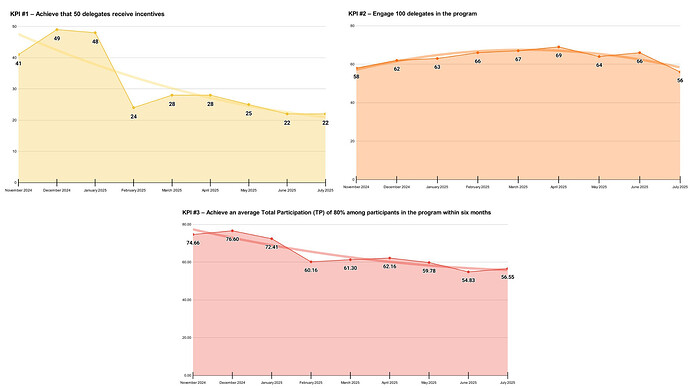
The original v1.5 proposal, approved on-chain, included specific KPIs set by @SEEDGov. The program is now failing to meet them.
As a reminder, these were the approved KPIs of the DIP, as per the onchain approval of the original DIP 1.5 version.
KPIs
In this new iteration of the DIP, we aim to establish the following KPIs:
- Achieve that 50 delegates receive incentives.
- Engage 100 delegates in the program.
- Achieve an average Total Participation (TP) of 80% among participants in the program within six months.
- Introduce improvements to the program after six months.
In the replies to this proposal, Paulo Fonseca has done a deep dive into the KPIs @SEEDGov hosted during the v1.5 vote
Delegates Are Losing Confidence
The most experienced delegates are walking away because the program is unstable.
“We’re now reducing involvement as we can’t know what (if any) compensation we will receive. Working up front without knowing if or how much you’ll be paid isn’t sustainable .” — cr1st0f, representing ACI, a major protocol delegate
“Most professional delegates would prefer some baseline/bottom line assurance. No bottom-end confidence until two weeks after month-end isn’t consistent enough for many delegates.” — DonOfDAOs, delegate
The Final Straw: A “Fix” That M
... please visit link below to view full proposal
Off-Chain Vote
Sunset the DIP
3 HVAXVC0.8%
Revert the DIP to v1.5
358 HVAXVC98.6%
Keep the current version
1 HVAXVC0.3%
Abstain
1 HVAXVC0.3%
Quorum:36300%
Timeline
Sep 04, 2025Proposal created
Sep 04, 2025Proposal vote started
Sep 10, 2025Proposal vote ended
May 12, 2026Proposal updated