[Non-Constitutional] - Updates to the DIP, The Complete 1.7 Version
Delegate Incentive Program V1.7
For the purpose of publishing the final text of the amended proposal on the public forum and Snapshot, we present it below:
General parameters
Duration
The program was initially approved for 12 months starting in November 2024; therefore, the last month of this iteration will be October 2025.
ArbitrumDAO may cancel the program or modify parameters, such as scoring methodology, through a Snapshot vote where the number of FOR votes to modify or wind down the initiative meets 3% of the votable supply level. If there are more voting options than the basic FOR/AGAINST/ABSTAIN, the option with the largest number of votes will be applied, given that the options to modify/cancel the initiative together exceed the 3% of the votable supply level.
Delegate Incentive Program Terms and Conditions
The DIP initially included the requirement that each DIP Participant must adhere to the social agreements reached by the DAO:
Each delegate must adhere to all social agreements reached through Snapshot, including those outlined in proposals such as ‘Improving Predictability in Arbitrum DAO’s Operations,’ ‘Should the DAO Create COI & Self Voting Policies?,’ ‘Incentives Detox Proposal,’ and any other proposals or codes of conduct that may be approved in the future.
In this iteration, and in light of what is outlined in the Rationale, we incorporated a specific set of Terms and Conditions for the program, to which DIP Participants must adhere to participate in the DIP.
Terms
DIP Participants: An individual or entity who applied to the Delegate Incentive Program and it’s eligible to participate in it, and/or is compensated via the DIP.
DAO Contributor: An individual or entity who willingly engages in Arbitrum governance and/or is compensated via a DAO-approved program.
Community Guidelines: The rules of engagement for the Arbitrum DAO forum as outlined and enforced by the Arbitrum Foundation.
Conflict of Interest (COI): A situation where a contributor, or any entity with which a contributor has a direct professional or financial relationship, stands to directly benefit from the outcome of a proposal or election.
1. Values Alignment
DIP Participants should always strive to uphold the seven community values stated below:
- Ethereum-aligned: Arbitrum is part of the Ethereum ecosystem and community
- Sustainable: Focus on the long-term health of the protocol over short-term gains
- Secure: Arbitrum is security-minded
- Socially inclusive: Open and welcoming to all constructive participants
- Technically inclusive: Accessible for ordinary people with ordinary technology
- User-focused: Managed for the benefit of all users
- Neutral and open: Foster open innovation, interoperation, user choice, and healthy competition
2. Good Faith and Best Interest
- DIP Participants should conduct themselves with honesty, integrity, and transparency, fostering trust and confidence among community members.
- DIP Participants should act and vote in accordance with what they see is in the best interests of Arbitrum, which encompasses but is not limited to all of the following: Arbitrum One, Arbitrum Nova, the Orbit Ecosystem, and any future Arbitrum DAO-governed chains.
3. Due Care and Attention
- DIP Participants should remain knowledgeable of developments in regards to Arbitrum DAO’s initiatives and the broader Arbitrum ecosystem.
- DIP Participants should make a professional and unbiased review of each proposal before submitting their vote.
- DIP Participants are advised to vote abstain when unable to conduct the necessary diligence to understand the proposals.
4. Civility and Professionalism
- While separate from the Terms and Conditions, DIP Participants are expected to uphold the community guidelines for activity on the Arbitrum DAO forum and de facto understood gathering places for the Arbitrum DAO, whether online or in-person.
- DIP Participants should seek to create a respectful and inclusive environment for all community members, free from harassment and discrimination.
- Unacceptable behavior includes, but is not limited to:
- Publicly or privately harassing or intimidating others
- Sharing someone’s private information without their consent
- Using sexualized language or imagery, or making unwanted advances
- Making insulting or derogatory comments about others
- Unacceptable behavior includes, but is not limited to:
- DIP Participants should strive to provide constructive feedback that is well-researched and respectful, focusing on the proposal’s merits. Personal attacks are never acceptable.
- DIP Participants should be open-minded and respectful of differing viewpoints, even if they disagree with them. Disagreements are an inevitable part of healthy debate, but they often yield positive results when approached in a civil manner.
- DIP Participants should make a best effort to provide constructive feedback through appropriate channels and avoid taking discussions to social media in a manner that could tarnish Arbitrum DAO’s brand and reputation.
- DIP Participants should avoid making unsubstantiated accusations that imply malice without proper evidence. They should conduct proper due diligence before making any public accusations via social media, public forums, or any other recognized communication channels. This includes exhausting all available avenues — for example, seeking clarification privately — before issuing any public statement that contains an unsubstantiated accusation about a DAO contributor.
5. Responsibility
- Maintaining a culture of productive debate, integrity, and transparency requires a sense of collective responsibility. As entrusted leaders of the Arbitrum community, DIP Participants should take responsibility in fostering and maintaining a culture that promotes the principles outlined herein.
- Best practices of responsible DIP Participants:
- Participation: DIP Participants should make an effort to vote (even if they vote abstain) on all proposals.
- Communication: DIP Participants should clearly communicate their rationale behind votes and discussions to the Arbitrum community.
- Accountability: DIP Participants should maintain knowledge of all DAO initiatives and hold managing parties or elected representatives accountable.
- Responsiveness: DIP Participants should use their best efforts to connect with the Arbitrum community and be accessible to answer questions or concerns.
6. Other Social Agreements
DIP Participants must adhere to the remaining social agreements reached by the DAO, with the understanding that, if there are contradictions between a Social Agreement (such as the DAO’s Code of Conduct) and the DIP’s Terms and Conditions, then the DIP’s policies shall take precedence.
Enforcement & Appeal Process
All DIP Participants are expected to abide by the DIP’s Terms and Conditions. The DIP’s Program Manager is the one responsible for determining violations of the Terms and Conditions and reserves the right to take what it deems as appropriate action, which may include but is not limited to, issuing a penalty, a warning, suspension, or a total removal from the program. Any DAO member can raise a concern to the Program Manager concerning a DIP Participant failing to uphold the DIP’s Terms and Conditions, and the Program Manager must provide an answer; however, the final determination and resulting course of action will depend on the Program Manager and/or the Appeal Process.
Regarding the appeals process, the following mechanism had previously been defined:
The affected delegate may request a Snapshot vote to ratify, change, or revoke the Administrator’s decision. This serves as a one-time appeal, and the decision made by the DAO will be final.
In the new iteration, appeals of any type of sanction (whether suspension or removal from the program) should be submitted by the affected DIP Participant to the Arbitrum Foundation, which would act as a neutral mediator in the situation and have the authority to ratify, change, or revoke the Program Manager’s decision.
In the future and once OpCo is fully operational, responsibility for the resolution of conflicts can be transferred to the OpCo at the Program Manager’s discretion. The Program Manager will acknowledge when this transfer can take place and make it public on the governance forum when it goes into effect.
Requirements to Participate in the DIP
The requirements to participate in the program are as follows:
- Voting Power: ≥500,000 ARB: New delegates with ≥500,000 ARB can apply in the subsequent month after they get that VP, unless they achieve it in the first 5 days of the month. DIP Participants should have this amount of VP for at least 25 days during the month*The Program Manager reserves the right to apply exceptions regarding this rule, as long as it provides a rationale for this decision.*DIP Participants already enrolled with less than 500,000 delegated ARB will be allowed to continue participating in the program. However, if in any given month they fail to meet the previous requirement (holding at least 50,000 delegated ARB for at least 85% or 25 days of the month) or any other requirement (as example maintaining a PR90≥75%), they will be required to reapply and meet the 500,000 ARB threshold outlined in this proposal.
- Participation Rate (Karma): ≥75% participation in on-chain votes in the last 90 days: In the Tier X case, the requirement of having a PR90 ≥ 75% will not be enforced to apply, but moving forward, the delegates will still need to comply with this requirement during their participation. This means that new delegates with 500,000 ARB will not have to wait three months to join the program. However, once they reach a PR90 ≥ 75%, they will be required to maintain it to remain eligible. This is a natural requirement, as they will need to vote regularly on Tally to reach the 50 Total Participation points.
- Adhere to the DIP’s Terms and Conditions and any other Social Agreement: Each DIP Participant must adhere to the DIP’s Terms and Conditions and all social agreements reached through Snapshot, including those outlined in proposals such as ‘Improving Predictability in Arbitrum DAO’s Operations,’ ‘Should the DAO Create COI & Self Voting Policies?,’ ‘Incentives Detox Proposal,’ [Non-Constitutional] Arbitrum DAO Delegate Code of Conduct + Formalizing the DAO’s Operations and any other proposals or codes of conduct that may be approved in the future. If there are contradictions between a Social Agreement (such as the DAO’s Code of Conduct) and the DIP’s Terms and Conditions, then the DIP’s policies shall take precedence. Current DIP Participants are considered to automatically adhere to the DIP Terms and Conditions unless they state otherwise. In this case, they will be excluded from the program, as adherence to these Terms and Conditions is a mandatory requirement for participation.
Incentive Program Application
Delegates who meet the requirements must confirm their participation in the DIP via the DIP Application Thread. Delegates can join the program anytime within 12 months, provided they meet the specified criteria. To minimize the potential for manipulation, delegates who sign up until the third day of the month will be included in the incentive calculations for that month. The Program Manager reserves the right to apply exceptions regarding this rule, as long as it provides a rationale for this decision.
Regarding DIP Participants’ Compliance Process
It is important to mention that it won’t be necessary for the DIP Participants already registered to complete the compliance process again
Incentive Program Application Template
- Forum Username (Link):
- Twitter Profile (Link):
- Telegram Username (Link or handle):
- Snapshot Profile (Link):
- Tally Profile (Link):
- Wallet Address (Link to arbscan):
- Participation Rate 90 days - Karma (Link):
- COI Disclosure:
- DIP’s Terms and Conditions Agreement: "As a participating member of the Delegate Incentive Program, I declare that I have read and understand the DIP’s Terms and Conditions in its entirety, and therefore, adhere to it in its entirety, being aware that non-compliance may result in suspension or removal from the program, with the Arbitrum Foundation as the sole appeal instance for such a decision.”
- Team composition (please add forum tags from team communicators): only applicable for organizations.
As a final note, it is worth mentioning that we rely on the good faith of participants regarding COI Disclosure and urge them to keep this information as up-to-date as possible so that if a new conflict arises, both the Program Administrator and the DAO can be aware of it.
Note: Any delegate who chooses to withdraw from the program can indicate their intention to opt out by posting a message in the forum.
Specific Parameters Breakdown
Maximum Number of Delegates to Receive Incentives
We will maintain this parameter at 50 delegates.
Tiers and Rewards
The Tier determines the final Reward (USD). Since Rewards are being calculated in USD but paid in ARB, each tier has an ARB Cap.
| Tier | TP% | Min (USD) | Max (USD) | ARB Cap |
|---|---|---|---|---|
| 1 | 90–100% | $3,600 | $4,200 | 12,350 |
| 2 | 75–90% | $2,500 | $3,000 | 8,800 |
| 3 | 65–75% | $1,800 | $2,000 | 5,900 |
| X | 50–65% | $1,000 | $1,500 | 4,400 |
The ARB Caps have been recalculated using 80% of the VWAP from the last 30 days at the time the Snapshot vote is published.
Note: The ARB 30-day VWAP on July 31st is $0.425 therefore the 80% of the VWAP is $0.34 which is the price used to recalculate the ARB Caps.
Monthly payments will be made using the last 7-day VWAP on the day the transaction is submitted to the Arbitrum Foundation.
Payments to delegates are expected to be processed in ARB from the Arbitrum Foundation Controlled Address between the 20th and the last day of each month.
Please note that this is an estimated timeline intended as guidance and does not constitute a binding deadline, as the actual payment date will depend on two factors:
- The date on which the Program Manager submits the transaction to the Arbitrum Foundation.
- OpSec/Compliance processes applicable to the Arbitrum Foundation.
It is also important to consider that any new DIP Participants who become eligible for a reward for the first time will need to complete the Arbitrum Foundation’s Compliance process. As a result, disbursements in these cases may be delayed beyond the dates specified.
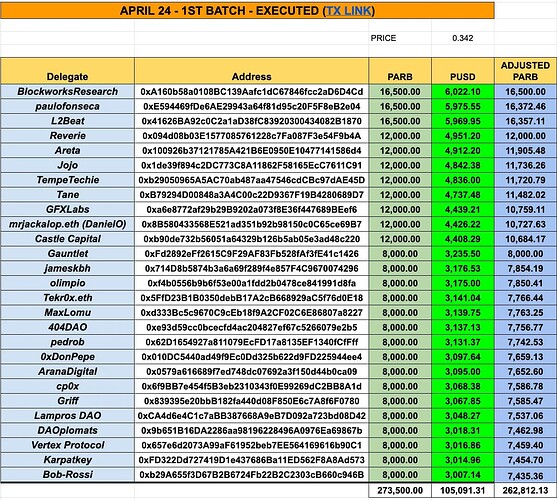
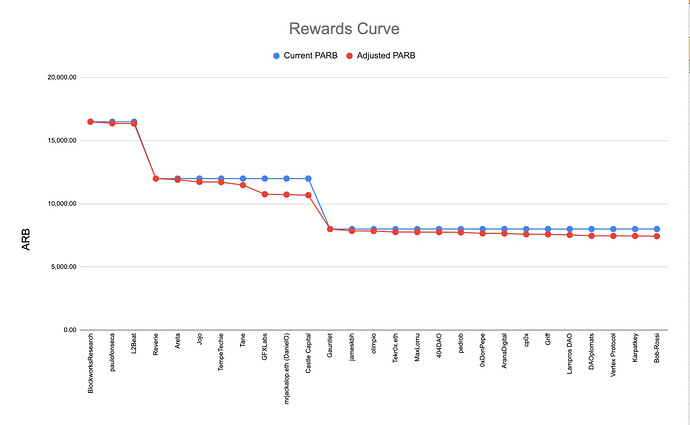
Proportional Adjusted Cap Method
- Only the delegate with the highest score in each Tier receives the full cap.
- The rest receive a reward proportional to their score.
- This maintains meritocratic incentives within each Tier.
Let’s suppose:
ARB Price = $0.20 Theoretical Max Payout for Delegate 1 = $4,200 → 21,000 ARB Tier Cap = 15,700 ARB Step 1: Calculate the adjustment ratio

Step 2: Apply that ratio to all theoretical ARB payouts within the Tier
Example with March Payments Batch 1:
Scoring
The minimum score to get a Reward is 50 Total Participation Points (TPP) for Tier X and 65 Total Participation Points (TPP) for Tier 3.
To determine which delegates will receive monthly payments, we will continue using the dashboard developed by Karma.
Note: The program manager may adjust the scoring parameters without the need for a DAO Vote, provided they inform the DAO of the reasons for the changes.
Voting Participation
1. Participation Rate (PR90) – Weight: 15 points
Tracks delegate voting activity over the past 90 days to measure consistency in participation.
Formula: (PR90 * 15) / 100
- PR90: The participation rate of the delegate over the last 90 days, expressed as a percentage.
- 15: Weight assigned to this parameter (15% of the total score).
Example: If a delegate has a PR90 of 80%, their score for this metric is:
(80 * 15) / 100 = 12
2. Snapshot Voting (SV) – Weight: 20 points
Measures participation in voting on Snapshot proposals during the evaluation month.
Formula: (SV(Rn) / SV(Tn)) * 20
- SV(Rn): The number of proposals the delegate voted on during the month.
- SV(Tn): The total number of proposals on Snapshot during the month.
- 20: Weight assigned to Snapshot voting (20% of the total score).
Example: If a delegate votes on 8 out of 10 proposals, their score for this metric is:
(8 / 10) * 20 = 16
3. Tally Voting (TV) – Weight: 25 points
Measures on-chain voting participation using the Tally platform.
Formula: (TV(Rn) / TV(Tn)) * 25
- TV(Rn): The number of on-chain proposals the delegate voted on during the month.
- TV(Tn): The total number of on-chain proposals during the month.
- 25: Weight assigned to on-chain voting (25% of the total score).
Example: If a delegate votes on 9 out of 12 proposals, their score for this metric is:
(9 / 12) * 25 = 18.75
4. Voting Power Multiplier (VPM)
A linear function that adjusts the scoring of the Voting Participation parameters by using a multiplier based on the Average Monthly VP of each Delegate.
Formula: 0.00000005063 * Delegate VP (monthly avg) + 0.7974685
- Minimum: 0.8 (for 50,000 VP)
- Maximum: 1.0 (for 4,000,000+ VP)
- Uses a weighted average of VP over the month.
b. Forum Engagement and other Contributions
1. DF (Delegate Feedback Score) - Weight: 40 points
Assesses the quality of a delegate’s feedback using a rubric with five criteria (e.g., clarity, depth, relevance). Feedback is scored from 0 to 10 (0 is reserved for penalties), and the presence in discussions acts as a multiplier.
Formula: (Σ qualitative criteria / 50) * 40 * Multiplier
- Σ qualitative criteria: The total score across the rubric (max: 50 points).
- /50: Normalizes the rubric score to a percentage.
- 40: Weight assigned to Delegate Feedback
- Multiplier: Based on the delegate’s participation in discussions.
Example: If a delegate scores 40/50 on the rubric and participates in 80% of discussions (multiplier = 1.2): (40 / 50) * 40 * 1.2 = 38.4
2. Bonus Points (BP) – Extra 30 points
Awarded for exceptional contributions, such as attending governance calls.
- 1.25% Bonus Points per Governance Report Call (GRC) attended.
- 1.25% Bonus Points per Open Discussion of Proposals Governance Call attended.
- Max Bonus Points per month from attending calls is 5%. The Program Manager reserves the right to make exceptional changes to this limit and to the specific calls to be rewarded.
| Governance Activity | New Bonus |
|---|---|
| Governance Report Call | 1.25% BP per call |
| Open Discussion of Proposals Call | 1.25% BP per call |
| Max Bonus Cap | 5% BP |
- The rest is reserved for extraordinary contributions.
- A DIP Participant can only get a total of 30 points between both concepts.
Parameters Overview Table
| Metric | Weight | Formula |
|---|---|---|
| Participation Rate (PR) | 15 | (PR90 * 15) / 100 |
| Snapshot Voting (SV) | 20 | (SV(Rn) / SV(Tn)) * 20 |
| Tally Voting (TV) | 25 | (TV(Rn) / TV(Tn)) * 25 |
| Voting Power Multiplier (VPM) | 0.8 to 1 | 0.00000005063 * Delegate VP (monthly avg) + 0.7974685 |
| Delegate Feedback (DF) | 40 | (Σ rubric score / 50) * 40 * Multiplier |
| Bonus Points (BP) | Extra | +30 TP |
Total Participation Points Calculation Steps
It combines all the aforementioned parameters to calculate the delegate’s overall score and it follows these steps:
- Compute PR90, SV, and TV individually.
- Sum these and apply the Voting Power Multiplier (VPM): (PR90 + SV + TV) * VPM
- Add Delegate Feedback Score (DF).
- Add Bonus Points (BP) - (Max 5% of (PR90+SV+TV)*VPM+DF).
- Final result determines the delegate’s performance or Total Participation score for compensation.
Formula: (PR% + SV% + TV%) * VPM + DF% + BP
Payment USD (PUSD) Calculation
Determines the monthly compensation in USD based on TP% and tier.
Formula:=MIN(4200, SI(TIER=X, 1000 + (TP-50)*(1500-1000)/(65-50), SI(TIER=3, 1800 + (TP-65)*(2000-1800)/(75-65), SI(TIER=2, 2500 + (TP-90)*(3000-2500)/(90-75), SI(TIER=1, 3600 + (4200-3600)/(100-90), 0)))))
- TIER = X,3,2,1: Compensation tiers based on Total Participation percentage.
- 1000, 1800, 2500, 3600: Minimum USD payments for tiers X, 3, 2, and 1, respectively.
- 1500, 2000, 3000, 4200: Maximum USD payments for tiers X, 3, 2, and 1, respectively.
- 50, 65, 75, 90: Minimum TP scores for tiers X, 3, 2, and 1, respectively.
- 65, 75, 90, 100: Maximum TP scores for tiers X, 3, 2, and 1, respectively.
- (TP-50)(1500-1000)/(65-50)(TP-65)(2000-1800)/(75-65)(TP-75)(3000-2500)/(90-75)(TP-90)*(4200-3600)/(100-90)Scales payment based on delegate performance within each tier.
Payment ARB (PARB) Calculation
Converts USD payment to ARB, capped by a tier-specific limit.
Formula:IF(PUSD/ARB Price > Tier Cap; Tier Cap; PUSD/ARB Price)
- PUSD: Delegate’s final USD payment.
- ARB Price: Last 7D ARB’s VWAP based on Coingecko.
- Tier Cap: Maximum ARB tokens for the delegate’s tier.
Note: Tier cap only applies if it’s the best delegate of the Tier, see details about Adjusted Cap Method above.
Other Specifications
Evaluation System for Delegates’ Feedback
Rubric
The rubric assesses the valid feedback provided by the delegate throughout the month (from day 1 at 00:00 UTC to the last day of the month at 23:59:59 UTC), based on a summary of their participation in various proposals and discussions. The aim is to measure the consistency, quality, and overall impact of their contributions.
- Key point: Feedback or opinions that violate community rules or the DIP’s Terms and Conditions will not be considered. Your interactions should contribute constructively to the discussions and improvement of the proposals.
Here is a breakdown of each criterion included in the rubric:
- Relevance: Analyzes whether the delegate’s feedback throughout the month is relevant to the discussion.
- Depth of Analysis: It evaluates the depth of analysis provided by the delegate concerning the proposals or discussions. This serves as a metric to assess whether the delegate takes the time to thoroughly meditate on the discussion and demonstrates attention to the details. Key elements include solid arguments, relevant questions, and thorough reasoning.
- Timing: Considers when the delegate provides feedback, rewarding those who provide feedback earlier, as long as they provide a valid contribution. Note that this parameter may be adjusted to Relevance, Depth of Analysis, and Impact on Decision-making parameters.
- Clarity and Communication: This is a review of the clarity, structured communication, and overall readability of the delegate’s feedback. Clear and well-written feedback is rewarded. Note that this parameter may be adjusted to Relevance, Depth of Analysis, and Impact on Decision-making parameters.
- Impact on Decision-Making: While the proposer ultimately decides whether to incorporate feedback, high-quality feedback from a delegate often influences the final proposal that goes to vote. This criterion evaluates whether the delegate’s feedback tends to drive changes in proposals/discussions.
- Presence in Discussions: This is a more quantitative analysis, intended to reflect the effort of DIP Participants who engage in the most relevant discussions. This parameter serves as a multiplier to the score obtained across the previous five criteria. The Program Manager reserves the right to include their own set of Discussions for this parameter each month.
1. Data Collection and filtering: At the end of the month, the complete set of contributions by each DIP Participant across all discussions on the forum is reviewed and the Program Manager will consult with the different proposers/key stakeholders to determine whether or not to include contributions made in the forum.
A criterion is established to determine when a comment is considered valid or invalid:
- Only comments with tangible impact (e.g., concrete changes in proposals) will be automatically considered.
- Contributions highlighted by proposers will also be valid. This includes pre-forum (draft) “invisible” contributions, as previously mentioned in the Rationale.
- The Program Manager may also include outstanding contributions.
- Key stakeholders (Contributors with ≥500,000 ARB delegated) may also publicly highlight or privately recommend a specific contribution to the Program Manager. The rationale behind this item is that if a specific comment from a Contributor had an impact on a Key Stakeholder with significant Voting Power, we can reasonably assert that such a contribution held value within the decision-making process.
Clarifications:
- The anonymity of those who propose valuable contributions under either of the two points above will be preserved.
- Proposers or other key stakeholders must disclose to the Program Manager any CoI with the DIP Participant who has made the highlighted contribution.
- The rubric will continue to be used to evaluate the contributions mentioned in points 1, 2, 3, and 4, so it is expected that, for example, a small change introduced to a proposal may carry more value than a significant one. This means the Program Manager will still have discretion to categorize and assess the contributions from points 1, 2, 3, and 4, although determining whether a comment is considered valid or invalid will no longer depend solely on the PM.
- The Program Manager reserves the right to exclude any of the contributions from points 1, 2, 3, and 4 due to CoI or potential collusion.
2. Overall Evaluation: After gathering all contributions considered “valid” for the month, a rubric is used to assess the delegate’s overall performance on each criterion, based on a holistic view of their participation.
3. Score Assignment: A level of 1 to 5 is assigned to each criterion, based on the consistency and quality of the DIP Participant’s contributions over the month. Each level has an assigned score, from 1 to 10. (0 is reserved for penalties)
4. Monthly Report: A qualitative and quantitative report summarizing the DIP Participant’s performance over the month is then produced.
Scoring Methodology
Each rubric criterion has levels with an assigned score, from 1 to 10, depending on the level achieved.
The initial score is obtained by adding the first five criteria, while the final score results from applying the “Presence in Discussions” multiplier to the initial average score. The maximum Initial Score is 50 points, and 40 points for the Final Score.
Exclusion of vote-buying platforms
Vote-buying platforms will be excluded from the Delegate Incentive Program, given that these platforms operate with their own economic incentives for how the Voting Power they acquire is used. The Program Manager reserves the right to revisit this decision if, in the future, the DAO gains greater clarity on the matter and finds it feasible to use the DIP as a mechanism for alignment with vote-buying platforms. This means that, if consensus is reached, pathways may be proposed to allow these platforms to participate in the program for the benefit of the DAO.
Conflict resolution
Dispute
If DIP Participants disagree with the results presented by the Karma Dashboard at the beginning of each month, they have a four-day period to contest them.
To raise a dispute, delegates must post a message in the forum using the following template:
- Title: Dispute
- Reason for Dispute (provide details)
The DIP administrator will address the issue promptly, with a resolution expected within a maximum of 4 days.
Important clarifications:
- Only objective parameters like votes (PR90, Snapshot Voting, and Tally Voting), call attendance, and dashboard errors can be disputed.
- Rubrics on DF and Bonus Points may receive feedback, but will not be altered. The Program Manager reserves the right to make amendments to the scoring of a DIP Participant after presenting the results.
- DIP Participants can’t dispute the scorings/assessments of other DIP Participants
DIP Ban
The program administrator will have the right to expel a delegate if they attempt to game or exploit the program or if the DIP Participant does not comply with the DIP’s Terms and Conditions. This decision is at the discretion of the program administrator. In all cases, the ban is permanent.
The affected DIP Participant may submit an appeal to the Arbitrum Foundation, which would act as a neutral mediator in the situation and have the authority to ratify, change, or revoke the Program Manager’s decision.
DIP Suspension
The Program Manager will have the right to suspend a DIP Participant if commits a fault that, in the Program Manager’s judgment, is insufficient cause for expulsion. The decision and duration of the suspension are at the discretion of the program administrator (duration can’t exceed the program’s current iteration).
The affected DIP Participant may submit an appeal to the Arbitrum Foundation, which would act as a neutral mediator in the situation and have the authority to ratify, change, or revoke the Program Manager’s decision.
DIP Scoring Penalty (New)
The Program Manager will have the right to penalize a DIP Participant if commits a fault that, in the Program Manager’s judgment, is insufficient cause for expulsion or suspension. The penalty could consist of allocating negative bonus points or marking a comment as valid with a score of 0 points to affect the average score in the Delegates’ Feedback Parameter.
The affected DIP Participant may submit an appeal to the Arbitrum Foundation, which would act as a neutral mediator in the situation and have the authority to ratify, change, or revoke the Program Manager’s decision.
In all cases (Ban, Suspension or Penalty), in the future and once OpCo is fully operational, responsibility for the resolution of conflicts can be transferred to the OpCo at the Program Manager’s discretion. The Program Manager will acknowledge when this transfer can take place and make it public on the governance forum when it goes into effect.
Program Growth Clause
At the moment of approving the 1.5 proposal, we had a Program Growth Clause that allowed the Program Manager to reopen discussions on the budget:
In light of the increase in Eligible Participants, the addition of new responsibilities such as the formalization of our authority to determine cases of non-compliance with the Terms and Conditions / DAO Code of Conduct, and our commitment to carry out a Business Development effort to onboard new DIP Participants into the program, we propose a 25% increase in the Program Manager’s compensation for the remaining four months.
Management and development of the Delegate Incentives Program: Responsibilities and Deliverables
The SEEDGov team and Karma will continue to collaborate to maintain and manage this new version of the DIP.
Program Dashboard Management (Karma)
Over the past six months, our team has successfully built and maintained the DAO’s compensation dashboard. Based on this experience, we anticipate the following work for the upcoming year:
- Infrastructure Maintenance and Expenses
- Ongoing Collaboration with SEEDGov
- Compensation Calculation Logic Updates
- Automation of Voting Statistics
- Verification of Statistics
Program Manager (SEEDGov)
- Check the corresponding data to see delegates’ eligibility.
- Collaborate with the Arbitrum Foundation to ensure delegates complete the KYC/KYB process and perform the necessary follow-up.
- Constantly monitor delegates’ activity.
- Support delegates with any questions or concerns related to the incentive program through Telegram, forum, or Discord.
- Collect feedback from delegates and the community to improve the program.
- Collect feedback from AAEs, proposers and other Key Stakeholders to assess DIP Participants’ contributions.
- Review delegate comments in the forum and filter out spam messages.
- Communicate to the DAO any changes in the incentive program
- Publish monthly results in the forum.
- Publish monthly program costs in the forum.
- Solve disputes
- Determine which DIP Participants receive Bonus Points.
- Collaborate with Arbitrum Foundation to ensure payments to delegates are processed each month.
- Periodic review of the information uploaded to the Karma dashboard.
- Have weekly meetings with Karma to fix bugs and enhance the dashboard.
- Prepare periodic reports
- Prepare a rubric and a monthly report about each Delegate’s feedback performance.
- Monitor the participation of the DIP Participants in the governance calls mentioned for the bonus points.
- Run a Business Development Effort to onboard new DIP Participants with ≥500,000 ARB delegated.
Deliverables
We commit to delivering:
- Monthly results of the DIP with Individual DIP Participants Reports
- Public cost reports allow for audits by any interested party.
- Mid-term and final evaluation reports of the program.
Additionals
- Hold meetings with contributors to gather feedback on the program and provide them with updates.
- Constantly work on improvements to the program.
Administrative Budget
Despite what we mentioned in the Program’s Growth Clause, the administrative budget won’t undergo any significant changes
Karma Details:
- $7,250/month * 12 = $87,000 for continuing to build and enhance the dashboard. (5 months remaining at the time of writing this post)
SEEDGov Details:
- 2 Program Administrators (2 Full-time): $169,000 over 12 months.
- 1 Data Analyst (Part-Time): $35,000 over 12 months.
Total: $204,000 ($16,000 per month from November to July and $20,000 from August to October) (4 months remaining at the time of writing this post)
KPIs
With the DAO’s shifting priorities and reduced operational burden for delegates, we believe the original goals may no longer be fully aligned with the current context. It’s important to note that this proposal was approved nearly 9 months ago, and naturally, in a fast-moving environment like crypto, some expectations become outdated.
The program naturally has two main objectives today:
- To support the DAO in achieving quorum, particularly for constitutional votes. It is a fact that a significant number of stakeholders require these incentives to justify the time they dedicate to reviewing proposals and voting with proper due diligence.
- To serve as a pipeline that supports external contributors who are interested in making valuable contributions and are looking to find their place within the DAO. In this way, the DIP has been functioning as a framework that attracts and retains talent within the Arbitrum ecosystem, especially when it comes to stakeholders with smaller amounts of delegated ARB.
Considering this, we propose the following KPIs for the remaining months:
- Currently, there are approximately 65 Contributors with ≥500,000 ARB delegated, of which 21 (115M VP approximately) are actively participating in the DIP. These 21 DIP Participants currently maintain an average Participation Rate of 85% in on-chain proposals. Since there is limited room for further improvement in terms of DIP Participants’ Participation Rate, one of the objectives will be to retain these DIP Participants, maintain the current average, and ideally increase it to 90%.
- Where there is indeed room for improvement is in the number of Contributors with ≥500,000 ARB delegated participating in the program. Currently, there are 35 out of the 65 Contributors with ≥500,000 ARB whose Participation Rate is below 75% (they have an average historical Participation Rate of 19.73%), and together they account for approximately 107M ARB in Voting Power. We will undertake a Business Development effort focused on onboarding to the program those Contributors who are above the threshold but are not yet participating. With the introduction of the new Tier X, we believe it will be easier to onboard these stakeholders by encouraging them to dedicate time to reviewing and voting on proposals with proper due diligence, in exchange for a reward. Therefore, we aim to onboard at least 5 of these Contributors with 500K or more VP, ideally 10 or its equivalent in Voting Power.
- Increase the ARB per USD Spent metric by 30% compared to last quarter: This means that the program will aim for greater efficiency when incentivizing Voting Activities, seeking to maximize the amount of ARB actively voting per dollar spent.
- Identify at least 5 contributors who can add value in specific verticals: So far, the DIP has demonstrated some success in attracting, identifying, and guiding contributors — especially those with lower VP — to deliver value within specific verticals.
Continuous Upgrades
The SEEDGov team and Karma are committed to gathering feedback, obtaining more information, and implementing the necessary changes to optimize performance. Considering the new duration of the program, the Program Administrator reserves the right to make changes in the scoring methodology by giving public notice in the forum.
Off-Chain Vote
For: Upgrade to v1.7
152.23M ARB80.4%
Against: Keep v1.6
767.09K ARB0.4%
Abstain
36.24M ARB19.2%
Timeline
Jul 31, 2025Proposal created
Jul 31, 2025Proposal vote started
Aug 07, 2025Proposal vote ended
May 29, 2026Proposal updated