Beets Budget 2026 Q2
Beets Budget 2026 Q2
Since its launch on Sonic, Beets has adopted a quarterly budget system designed to provide governance-controlled flexibility, allowing the protocol to adapt emissions to changing market conditions while safeguarding the token supply and community interests. Under this system, the Music Directors present a BEETS budget for DAO approval every three months, covering the upcoming quarter. Each budget outlines the number of BEETS to be minted and their allocation within the ecosystem. It also specifies the distribution of protocol revenue for that quarter.
The 2026 Q1 budget will conclude at the end of March. The 2026 Q2 Budget will cover the period from April through June. We first introduce an overview of the 2026 Q1 Budget so far (excluding March) and then provide the proposal for the 2026 Q2 Budget.
Overview of the 2026 Q1 Budget
Total budget for Q1 was 7,420,000 BEETS tokens:
The table below shows the total Q1 allocations alongside the values as of the end of February:
By the end of February, 3,610,907 BEETS tokens had been used in total from the Qq Budget. The remaining Budget is expected to be spent by the end of March as follows:
- 840,000 BEETS - BEETS distributed based on the gauge vote results
- ~700,000 BEETS - BEETS distributed based on the MD Discretion
The Music Directors planned their distribution with a reserve of tokens to cover potential specific use cases. Additionally, due to the economic status of the chain, the MDs have not been allocating their full budget. With this, the Q1 budget will likely conclude with a total surplus of approximately 2,000,000 BEETS.
Protocol revenue distributions have followed the allocations outlined in the Q1 Budget. The table below details the revenue sources and their respective allocations:
(Treasury - Towards DAO treasury; maBEETS - Towards BEETS buybacks to be used as protocol bounties on Sonic gauges votes; BEETS BB - Towards BEETS buybacks to be used in the next budget; Other - Extra incentives and revenue share with partners) *With the launch of v3 on Optimism we have different fee structures for v2 and v3 pools and thus the total Optimism allocation percentages are an approximation.
By the end of February, a total of 3,139,666 BEETS had been bought back from the open market. Of this amount, 1,281,550 BEETS were used as protocol bounties for Sonic gauge votes, while 1,858,116 BEETS were reserved for the next quarterly budget:
Extrapolating from this data, we estimate that approximately 2,700,000 BEETS will be available for the 2026 Q2 Budget from Q1 buybacks.
Proposal for the 2026 Q2 Budget (April - June)
Based on the current figures for the 2026 Q1 Budget, we estimate an expected surplus of 2,000,000 BEETS, along with an additional 2,700,000 BEETS from buybacks, to be carried over to the 2026 Q2 Budget. Based on BIP-100, any additional BEETS required would be repurposed from the unmigrated supply instead of minting new BEETS.
For the 2026 Q1 Budget, we present two options for DAO members to vote on. The options are summarized as follows:
Option A – Maintain a budget similar to the current one, with an emphasis on BEETS buybacks and low BEETS emissions. Option B – Increase gauge-vote allocation and maBEETS protocol bounties, with an emphasis on gauge-votes and maBEETS voting incentives.
1. BEETS Budget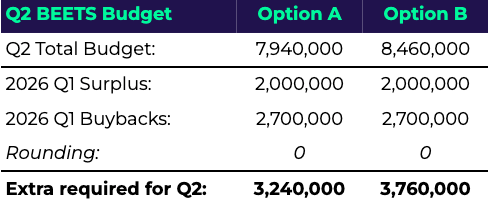
The table above shows the amount of BEETS that would be repurposed from the unmigrated token supply under either option. These figures are approximations; the final amount will be determined based on the complete Q1 results. For reference, a total of 3,243,885 BEETS was required extra for the 2026 Q1 Budget.
2. BEETS Allocation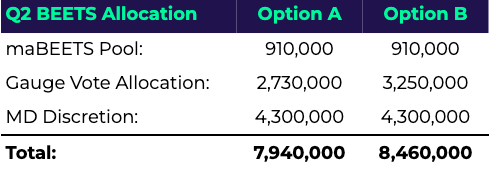
The budget would cover 13 weekly deposits and a total of 91 days.
Under both options the direct incentives to the maBEETS pool are 10,000 BEETS/day. MD discretion is 300,000 per week + 400,000 reserve. The difference is on gauge vote allocation, Option A would continue to have 210,000 BEETS/week allocated according to gauge vote results, while under Option B this has been increased to 250,000 BEETS/week.
3. Protocol Revenue Allocation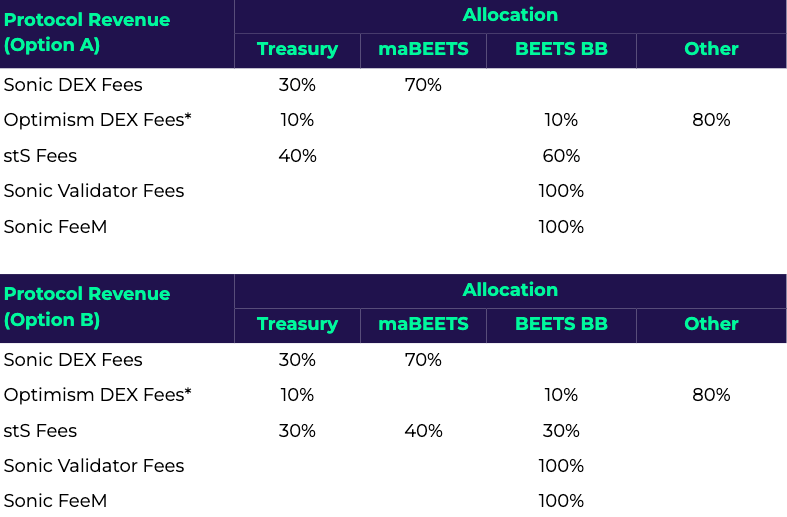
*Optimism DEX Fees are an approximation based on the partnership agreement between Beets and Balancer.
Under Option A the protocol revenue allocation would remain unchanged from the current budget. This structure prioritizes BEETS buybacks, which are then used to fund the next quarter’s proposal, reducing the need for newly minted or repurposed tokens.
Option B would introduce a change to stS fee allocations, directing a portion of these fees toward gauge vote protocol bounties distributed to maBEETS voters (note that under the current protocol fee processing mechanics, using additional revenue sources for this purpose would be cumbersome).
Off-Chain Vote
Yes (Option A)
7.81M maBEETS93%
Yes (Option B)
583.93K maBEETS7%
No, needs revising
0 maBEETS0%
Abstain
0 maBEETS0%
Quorum:210%
Discussion
Timeline
Mar 25, 2026Proposal created
Mar 25, 2026Proposal vote started
Mar 29, 2026Proposal vote ended
Mar 29, 2026Proposal updated