BSN Emissions for Stakehouse
This proposal is an outline to create emissions of BSN tokens for Stakehouse LSD Network participants. The core proposal is listed below as well as the previous Temperature Check.
- The quorum is set at 200 Million BSN tokens.
- The proposal will be open for voting for 3 days.
- 1 vote per BSN token.
Fair caution: There is not a substantial amount of BSN tokens in circulation. If a quorum is not met, a simple majority will decide the outcome.
In this case, the voting is more of general sentiment and signaling for this proposal and is taken in good faith for the positive growth for the DAO protocol in discussion (Stakehouse LSD Networks). This is not a sustainable precedent and will not be used for voting after there is substantial BSN in circulation.
Outcomes
Proposal Passes
Blockswap Labs will be entrusted with all execution, implementation, communication, design, and everything else that goes with the proposal. This will be done to the best of their ability and contingent on what is technically and logically possible.
Proposal Fails
The community can reassess and determine the best way to get this proposal to pass.
[Proposal] BSN Emissions for Stakehouse
Introduction
On March 10, 2023, a Temperature Check was conducted for the Blockswap DAO community to feedback on emissions for Stakehouse. The community was able to voice their thoughts about the potential for BSN distribution.
This proposal will outline feedback and updates to the Temperature Check to outline an effective proposal for BSN Emission for Stakehouse.
Community Feedback
In general, the feedback was positive and in favor of BSN emissions for Stakehouse LSD Networks. Feedback was collected from both the proposal on the governance forum and Discord. The overall thought was that it aligned with DAO bootstrapping and finding quality members who are value aligned with Blockswap Protocols. The feedback from the community can largely be categorized into two buckets.
Increase Adoption
Community members voiced their excitement in anticipation of rewards for staking validators. The thought was that this was an adequate route to bootstrap liquidity for Stakehouse LSD Networks stakers. By heavily front-weighting rewards it could get a high amount of dETH into the marketplace to find deeper integrations into the wider DeFi market.
The main focus here was on finding meaningful growth and DAO members.
Emissions Rate
There were some who thought that BSN emissions might be too high for the first few validators.
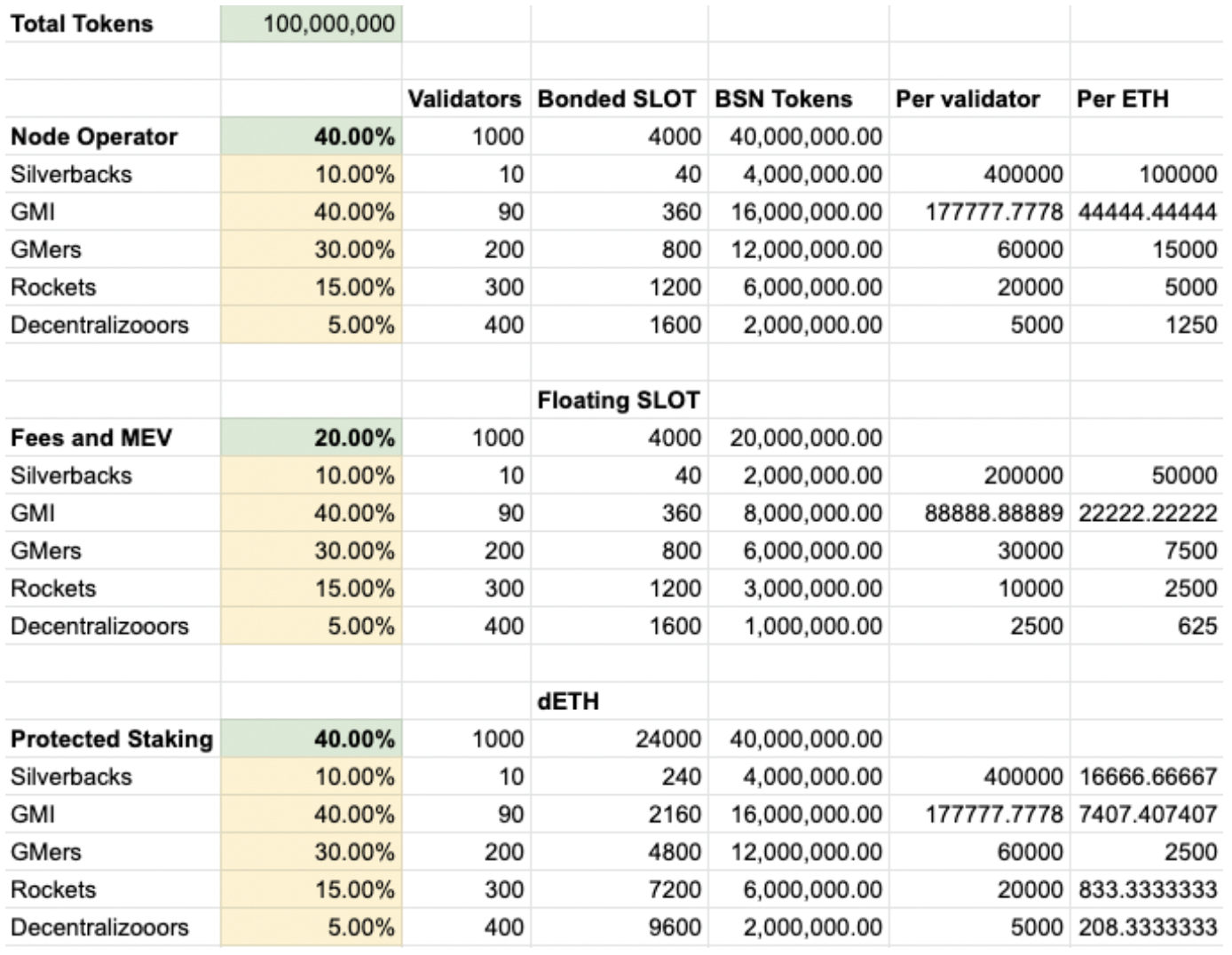
The outlined emissions Temperature Check has a target of 1,000 validators with front-weighted rewards for the first validators. If the target is not met, there may not be sufficient liquidity to find deep integration in DeFi. Therefore, it is important to consider the last group of validators when determining the rewards distribution rate as that is where further protocol and asset adoption are possible. This last group which contains 40% of the total validators has an average rate of 12,500 BSN per validator.
Additionally, there is nothing preventing anyone from participating in Stakehouse Emissions and having the same opportunities available. Any perceived misalignment could have come from not having an intention of using Stakehouse. If that is the case, then they are likely not as aligned with the Blockswap DAO as those willing to use the DAO protocols. Stakehouse is permissionless.
Implementation
The DAO will empower the core contributors Blockswap Labs to facilitate all aspects of the execution of the BSN Emissions for Stakehouse. A few key points to note about the proposal.
- 100,000,000 BSN of the 2,650,000,000 held by the DAO will be allocated for the initial Stakehouse Emissions.
- The emissions will be tiered and only distributed when each tier is complete.
- If passed this will start Tuesday, March 21, 2023 and conclude in 120 days returning all remaining tokens to the DAO. Validators staked before March 21, 2023 will qualify retroactively.
- Node Operators will have a delay in receiving emissions to determine the quality of node operating based on staking rewards generated.
- Blockswap Labs will be entrusted with all execution, implementation, communication, design, and everything else that goes with the campaign. This will be done to the best of their ability and contingent on what is technically and logically possible.
- Rewards will be retroactive to all stakers in LSD networks since the protocol went live on March 3, 2023.
- Additional details can be found in the Temperature Check below.
As a quick reminder, below are the tentative emissions. Please note that this will likely be on a curve with earlier stakers receiving more than later stakers. For Node Operators the BSN mining is related to the staking rewards earned. This ensures uptime for Node Operators. The below is for informational purposes only and used as a visual reference.
Conclusion
The next steps will be executed by Blockswap Labs. Snapshots will be taken and a UI shared for users to claim BSN. If you have any questions or comments please feel free to share them.
[Temperature Check] BSN Emissions for Stakehouse
Introduction
This Temperature Check will outline a method to create emissions of the BSN tokens for early adopters of Stakehouse LSD Networks. It is in the best interest of the DAO to distribute tokens to those who support its protocols.
Motivation
Stakehouse LSD Networks is the first protocol owned entirely by Blockswap DAO. Therefore, the DAO should support its wider adoption as 53% of all BSN tokens are owned by it. One of the simplest and most time-tested protocol adoption and token distribution strategies has been through emissions for protocol participation. It makes sense for the DAO to allocate tokens to those who stake ETH using Stakehouse LSD Networks.
Objectives
- Increase the protocol adoption rate by incentivizing Stakehouse LSD Network participation.
- Find value-aligned DAO members who have a vested interest in Blockswap DAO protocols.
Structure
When discussing the structure for token emissions, it should be broken down into categories. Stakehouse LSD Networks has three staking options, Protected Staker, MEV Stakers, and Node Operators. We can utilize these segmented user groups when determining separate parties vested in the same interest. When thinking about these groups it is important to take into consideration the amount of ETH required, current token holders, anticipated risks, and the future of Blockswap.
In brief, below are the user segments.
**Node Operators - **are required to provide a 4 ETH bond to receive 50% of the revenue from the MEV payouts pool proportional to their ownership of that pool. Node operators have complete autonomy so rewards should be treated on a sliding scale based on staking rewards generated.
MEV Stakers - can stake any amount and receive the other 50% of MEV Revenue based on their proportion of the pool. There are 4 ETH per validator in this segment. MEV Stakers do not operate a validator and should receive rewards as they become available.
Protected Stakers - receive 100% of the staking rewards from the 32 ETH validator to only 24 dETH. This represents a 33% increase in rewards over the Ethereum Deposit Contract rate. Protected Stakers do not operate a validator and should receive rewards as they become available.
Emissions Rate
The BSN DAO should consider emitting 100,000,000 tokens to the first 1,000 validators staked in Stakehouse LSD Networks. This would represent 3.8% of the DAO’s tokens. 1,000 validators is a significant number as it will provide ample liquidity for dETH to become integrated into DeFi protocols. This would represent under .2% of all staked ETH as of March 8, 2023.
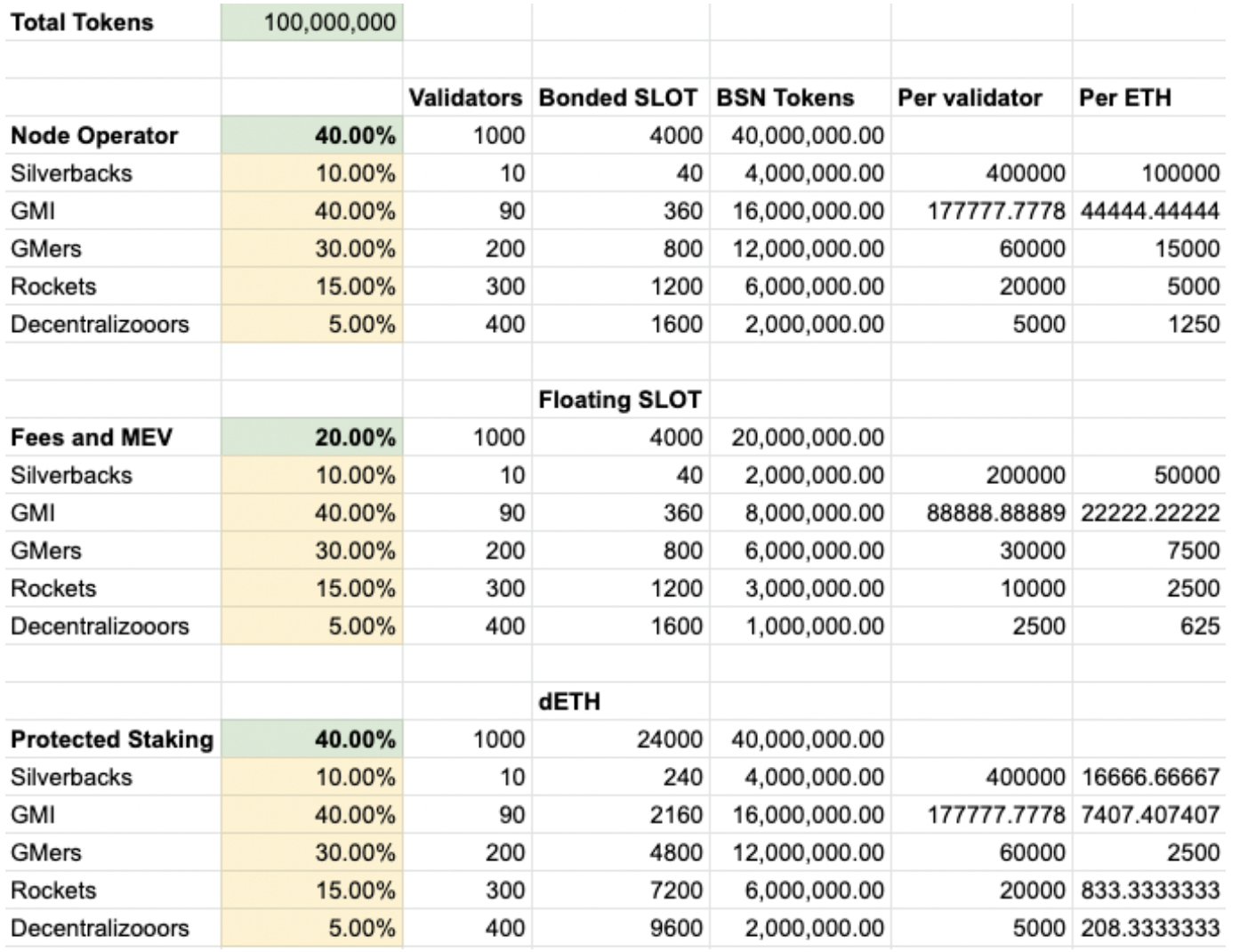
Below outlines a front-weighted distribution of BSN tokens. The intention is to encourage early adopters and aid to soften the perceived risks of being the first few users in a groundbreaking protocol. Tokens will be distributed after each group has been completely staked. The first validator staked in each group will be given a higher weight of rewards than the next validator. This campaign can run for 120 days.
- Group #1: Silverbacks
- Validators: 10
- Percent of allocated BSN: 10%
- Group #2: GMI
- Validators: 90
- Percent of allocated BSN: 40%
- Group #3: GMers
- Validators: 200
- Percent of allocated BSN: 30%
- Group #4: Rockets
- Validators: 300
- Percent of allocated BSN: 15%
- Group #4: Decentralizooors
- Validators: 400
- Percent of allocated BSN: 5%
Each one of these groups can then be broken down into subgroups based on their level of participation listed above.
- Node Operators: 40%
- Rewards will be based on performance accruing staking rewards.
- Vested for 90 days after the threshold has been reached.
- MEV Staking: 20%
- Target distributing BSN within 2 weeks of the threshold being reached.
- Directly proportional to their percentage of the pool.
- Protected Staking: 40%
- Target distributing BSN within 2 weeks of the threshold being reached.
- Directly proportional to their percentage of the pool.
Here is what it looks like put together.
More Details
Qualifying will require a user’s tokens to be staked in the Ethereum Deposit Contract. That means that a simple deposit shall not qualify unless the ETH is in a validator. These tokens can be made available via a UI by the DAO. The DAO will empower Blockswap Labs to facilitate, execute, and communicate the deployment of these emissions.
Summary
- The DAO allocates 100,000,000 BSN for the first 1,000 validators.
- The emissions program runs for 120 days after implantation. Afterward, any unallocated tokens will revert back to the DAO.
- Rewards will be assigned retroactively; Validators that are staked prior to the implementation date will still qualify for BSN rewards.
- BSN tokens are given in proportion to the percentage of ownership of the MEV and Protected Staking and are scaled based on the performance of node operators.
- Each group must be completed in its entirety or else rewards will not be distributed.
- Validators will be ranked in the order they are staked in each group. Example: the first ETH staked as a protected staker in the first validator will receive more rewards than the second even if they are in the same group.
- The DAO empowers core contributors Blockswap Labs to outline, create, develop, deploy, and provide support, etc for these BSN emissions.
Conclusion
This is a Temperature Check to gauge community interest in creating BSN emissions for Stakehouse LSD Network users. Scaling the emissions to favor the first few validators and varying the rates for each staking pool could yield better results. All feedback is welcome.
Off-Chain Vote
Yes
68.59M BSN100%
No
0 BSN0%
Timeline
Mar 17, 2023Proposal created
Mar 17, 2023Proposal vote started
Mar 20, 2023Proposal vote ended
Oct 26, 2023Proposal updated