EAS Resolver fees research
Description
Research and vulgarization about Ethereum Attestation Service (EAS ) and resolver fees.
Problem
The EcoID protocol team started to work on a V2 of the EcoID. If we succeed to prove that EAS is a better alternative than the current EcoID V2 draft, we might make the team save a decent amount of time.
One of the promising opportunities opened by EcoID is the fact that Verifier can build a business on top of the protocol by charging fees to the receiver of their attestations.
If the Ethereum Attestation Service looks like a promising alternative to EcoID, we need to first validate that EAS offers us an equivalent solution.
Why
Eco id currently comes with a set of limitations :
-
No standardization
-
Only used within the Eco community
-
High Fees
-
only available on Ethereum
-
only possible to make one attestation at a time
-
-
All claims rely on trusting the Verifier making the attestation
-
Not permissionless: a receiver needs to give its approval
-
EcoID playground is currently the only tooling available
On the other side, EAS overcomes the following limitations:
-
Attestation is enforced through schemas
-
Organization following EAS :
-
Founded by Ethereum Foundation
-
Live on Arbitrum mainnet
-
Live on Optimism Goerli, will be live on mainnet on the 6th of June 2023
-
Live on Coinbase : Base Goerli
-
-
Cheaper fees
-
Available on L2
-
Batchable: multiple attestations can be made at once, reducing fees
-
-
Trust can be trustless, or Permissionless
-
EAS shipped with nice tooling :
-
An attestation explorer for anyone to verify attestations
-
A no-code schema builder for easily creating schemas
-
A no-code attestation maker to easily make attestations
-
An SDK for increasing the speed for devs to experiment & integrate EAS
-
The ability to make verifiable off-chain attestations.
-
Developer documentation to get started for all levels of technicality
-
Educational resources to understand EAS
-
Success
We want to highlight the possibilities and limitations of the Ethereum Attestation Service (EAS) protocol to fulfill an equivalent of the EcoID capability :
- allowing Verifiers to develop business via a fee-per-attestation mechanism.
Audience
Eco****ID protocol team
Details
The strategy will take place in 3 distinct steps :
-
Build a working example
-
Documenting the process
The 2 first steps will be the example of a Verifier paid in ECO Token via a Free Resolver

Roadmap
If this proposal gets approved, the following deliverables will be shipped within a 3 weeks time frame after approval.
Team
@Jeremie
@LinaHello
Deliverables & added value
-
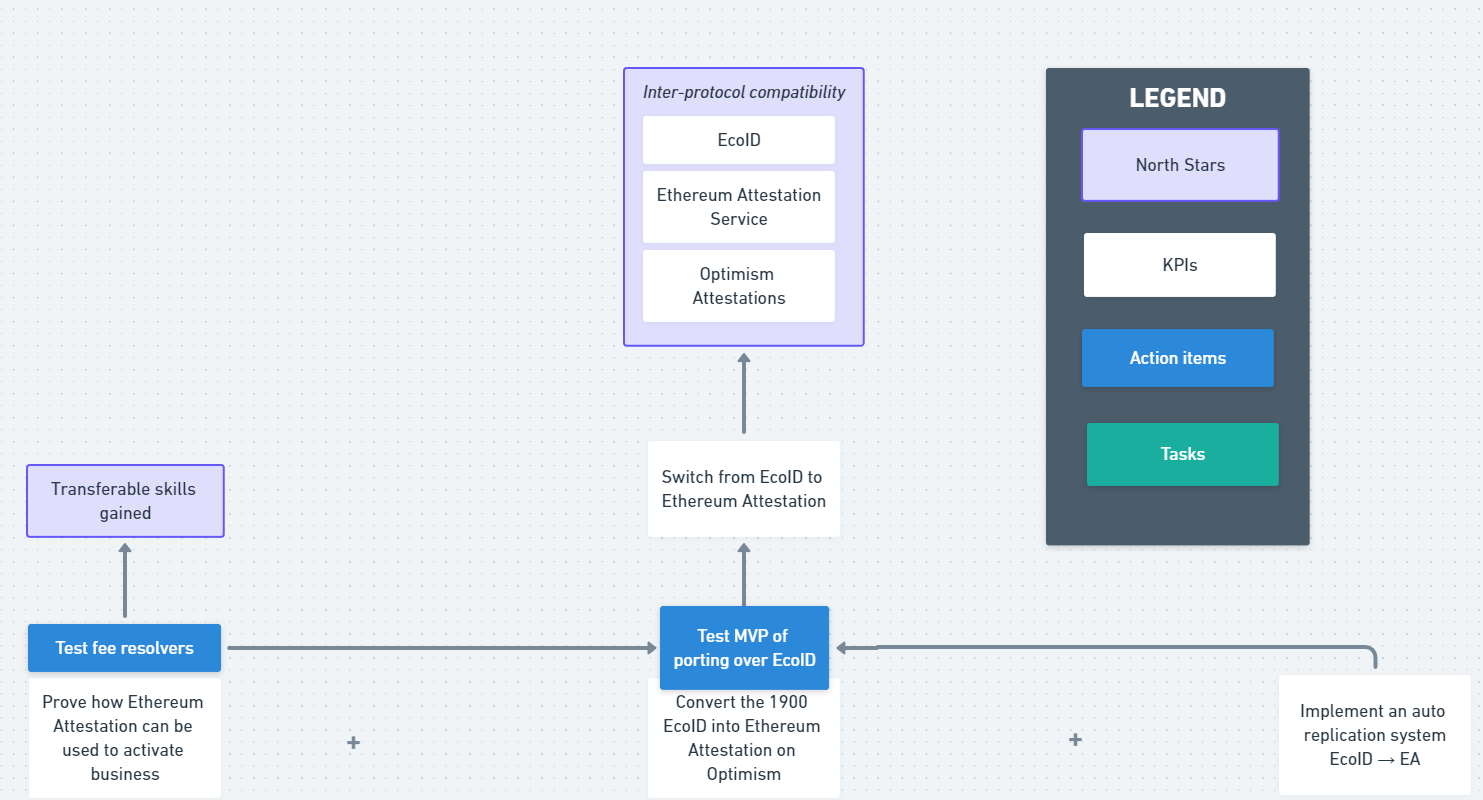
A working example of a Verifier receiving ECO Token by delivering an attestation to a Receiver paying the fees as illustrated in the diagram above
-
GitHub Repo
-
User Guide: how to reproduce (deployment, schema attestation, attestation generation getting paid in Eco)
-
User Flow to illustrate the process
Further development
In case that EAS provides a similar feature:
Funding
We request a budget of 2500$ worth of Eco token at the time of the payment.
Founds destination
The team will send the payment request and detail about its distribution after the project delivery if accepted.
Off-Chain Vote
Timeline
Jul 18, 2023Proposal created
Jul 18, 2023Proposal vote started
Jul 21, 2023Proposal vote ended
Oct 11, 2024Proposal updated