[HIP-13] Sport Specification Proposal: Accumulating
This proposal has been revised and contains changes to the Determining Protocol’s Rewards Section.
I. Introduction
We are pleased to introduce the Sport, ‘Accumulating’, a new category within the 'Hermes Games' also known as the Hermes Partnership Program.
This initiative seeks to invigorate competition, growth, and community involvement among participating protocols, all while upholding the highest standards of transparency and ethical conduct. This document delineates the key features, execution strategy, governance implications, community engagement approach, subsequent actions, and the decision-making framework for the seamless integration of the 'Accumulating' Sport into the ‘Hermes Games’.
II. Background and Rationale
Our initiative is deeply anchored in Ethereum's foundational tenets: decentralization and an unwavering allegiance to open-source development. We prioritize alliances with protocols that resonate with these principles, either through open-source endeavors or a steadfast commitment to decentralization.
By aligning with Ethereum's ethos, we aspire to cultivate a dynamic ecosystem of projects unified by a shared vision of transparency, inclusivity, and community-led innovation. We are convinced that decentralized protocols are pivotal in harnessing the full potential of blockchain technology, ensuring enhanced security, robustness, and scalability.
III. Considerations
Crafting an equitable reward distribution mechanism for an event like the Hermes Games demands a nuanced approach that harmonizes multiple variables. The methodologies under consideration include:
-
Time-Indexed Rewards: To level the playing field, rewards could be apportioned based on participation duration, ensuring equitable distribution throughout the Games.
-
Merit-Based Rewards: Rewards could be allocated in line with participants' performance, gauged by metrics like EV+ actions, bHERMES accumulation, or burning $HERMES.
-
Stratified Rewards: A tiered system could be employed, where top achievers garner a more substantial reward share, but all participants benefit.
-
Stochastic Rewards: Introducing an element of serendipity, sporadic bonus rewards could be granted to random participants.
-
Community-Powered Voting: Empowering bHERMES holders to influence reward distribution based on participants' performance or community contributions.
IV. Proposal Details
A. Determining Protocol’s Rewards
In the 'Accumulating' sport, we evaluate protocols based on a set of defined rules and a key metric to precisely measure the accumulation of bHERMES within a Partner bHermes contract. As a token of appreciation, participants stand to receive various rewards, including the opportunity for a social media announcement showcasing their active involvement and progress. Additionally, it's worth noting that our Utility Manager contract provides a flexible solution for managing bHermes utility tokens, offering the ability to control and utilize them without the option to withdraw the bHermes itself. This implementation serves as an example, demonstrating the versatility of our approach.
To prevent any manipulation of this sport, we track accumulated bHermes on a weekly basis throughout the season. To calculate rewards, we measure the growth of bHERMES in a given 'Partner bHermes' vault over a week, and allocate rewards to all participants for that week in proportion to their contributions. Participants must represent at least 1% (>=1%) of the weekly accumulated bHermes to be eligible for rewards. The reward distribution takes place at the end of each season.
With the aim of encouraging continuous protocol adoption, participants holding more than 10% of the locked supply can earn a corresponding percentage of the weekly prize pool in this sport. For instance, a protocol with 20% of the locked supply can receive up to 20% of the prize pool.
B. Olympic bHermes Sustainability
As we have outlined previously, the ‘Hermes Games’ Grant Program is to be funded an allocation of 30,000,000 bHERMES tokens as approved by governance in [HIP-5] Hermes Olympics: Ecosystem Retroactive Grant Program.
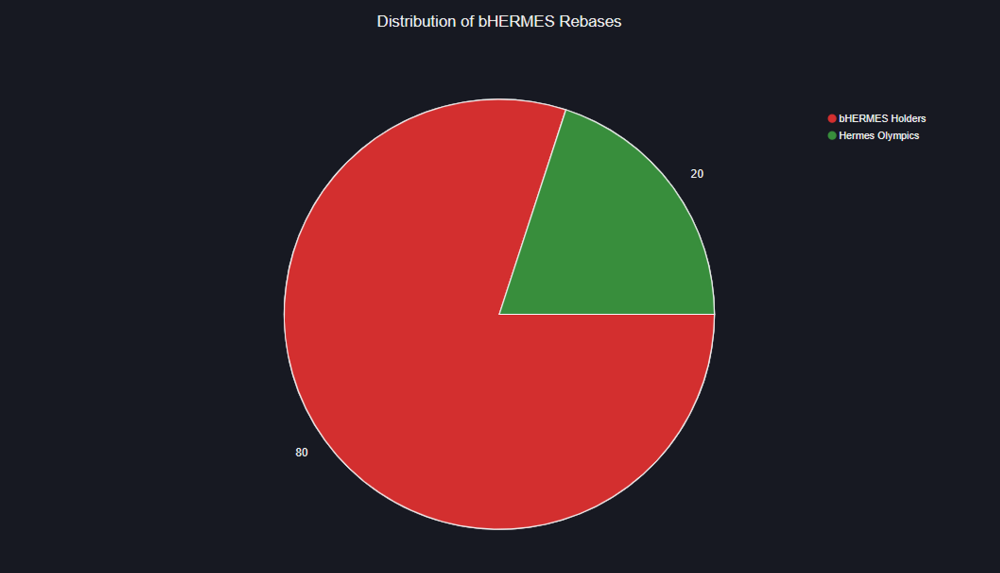
As we approach the launch of V2, we are closing in on a total locked supply of about 120,000,000 veHERMES and 1,000,000 in rebases per week for veHERMES distribution.
Based on 30,000,000 bHERMES minting for the Hermes Partner program, the weekly reward pool would consist of 200,000 $HERMES. Thus, a 12-week season would amount to approximately 2,400,000 $HERMES in distribution.
The chart below gives a historical overview of emissions to liquidity providers and distributions to veHERMES voters. While this data is insightful, it's essential to understand its limitations as the past cannot accurately predict future behavior.
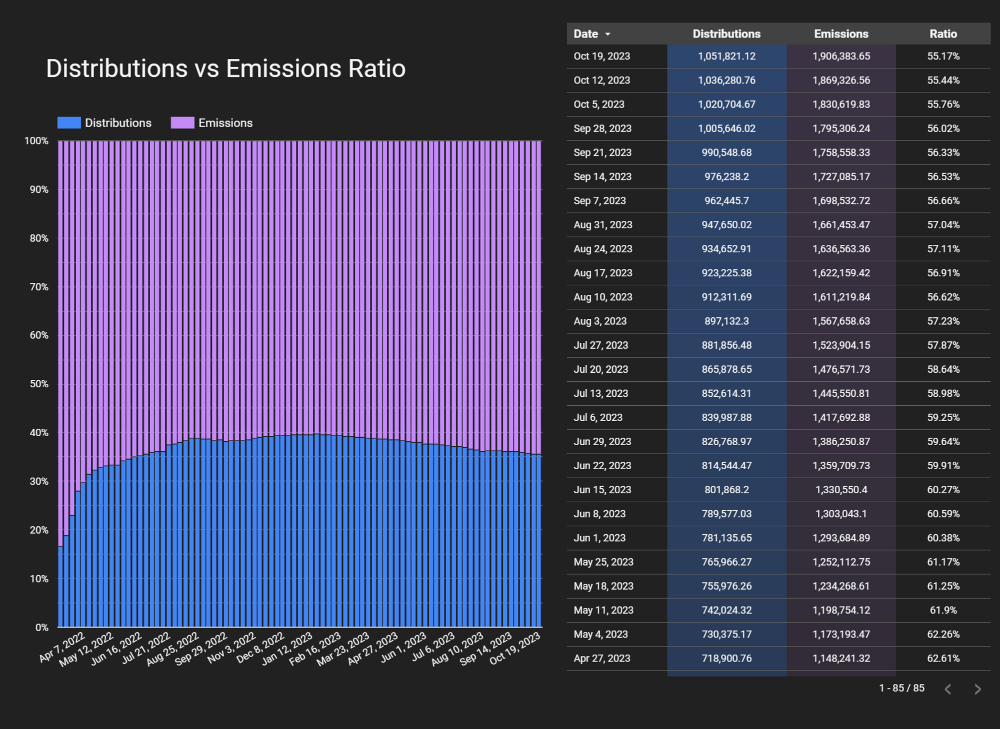
What we can infer from this data is how the market and protocol reacts in situations with fewer locks and gradually increasing emissions. In simpler terms, this refers to a scenario where emissions in each successive week are greater than those from the previous week.
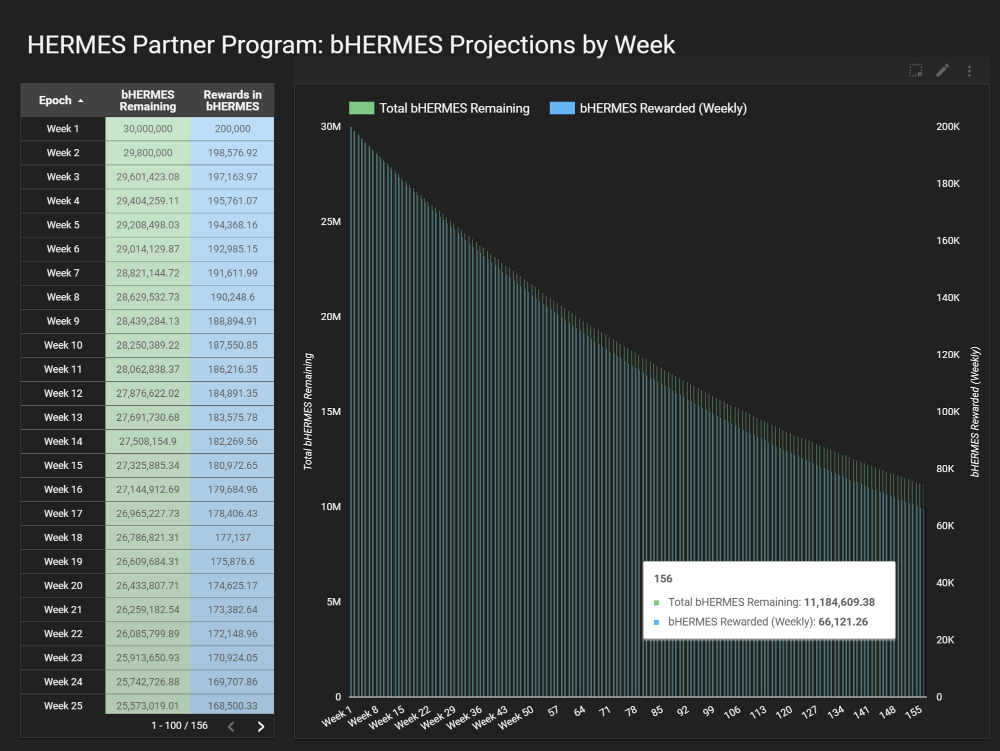
The chart presented above delineates the anticipated growth trajectory for 30 million $bHermes, based on an assumed 43.3% Annual Percentage Yield (APY) while allotting a constant weekly rewards of about 25% of distributions through the Hermes Games.
By week 156 (3 years), the allocation of 66,121 bHERMES corresponds to 200,000 $HERMES. This relationship yields a bHERMES to HERMES ratio of 1:2.89. It is imperative to note that this ratio is predicated on the maintenance of a constant 43.3% APY.
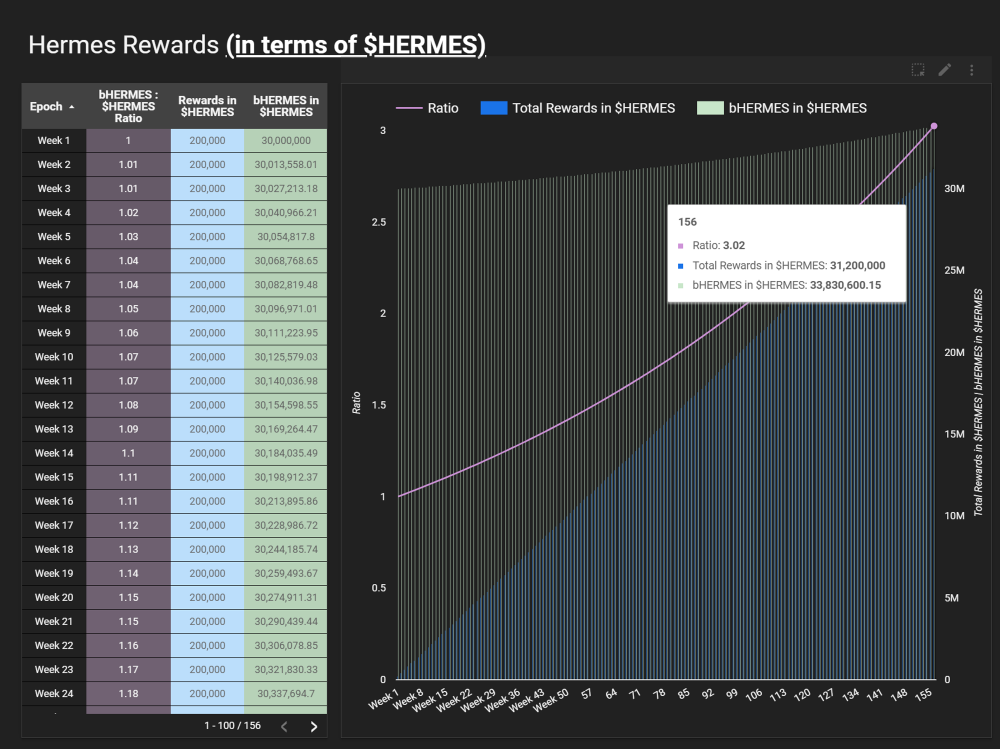
In a hypothetical worst-case scenario where the locking ratio in V2 mirrors that of the current V1, the Hermes Games contract would distribute a total of 39,000,000 $HERMES worth of bHERMES over a period of 156 weeks. Even after three years of sustained rewards equivalent to 250,000 bHERMES the Hermes Games would have over 12,617,551 bHERMES left in the contract.
On the other hand, in a best-case scenario with increasing locks and decreasing emissions and distribution, this is potentially what we may see:
| Weeks | Initial Circulating Supply | Weekly Decrease | New Circulating Supply | Minimum Weekly Increase | Weekly Rebase | New APY (%) |
|---|---|---|---|---|---|---|
| 1 | 80,000,000 | 800,000 | 81,200,000 | 1,600,000 | 1,000,000 | 43.3 |
| 2 | 81,200,000 | 812,000 | 80,388,000 | 1,607,760 | 987,760 | 6.99 |
| 3 | 80,388,000 | 803,880 | 79,584,120 | 1,591,682 | 975,841 | 6.88 |
| 4 | 79,584,120 | 795,841 | 78,788,279 | 1,575,766 | 963,765 | 6.77 |
| 5 | 78,788,279 | 787,883 | 78,000,396 | 1,560,008 | 951,765 | 6.67 |
| 6 | 78,000,396 | 780,004 | 77,220,392 | 1,544,408 | 939,808 | 6.57 |
| 7 | 77,220,392 | 772,204 | 76,448,188 | 1,528,964 | 927,964 | 6.47 |
| 8 | 76,448,188 | 764,482 | 75,683,706 | 1,513,674 | 916,374 | 6.38 |
| 9 | 75,683,706 | 756,837 | 74,926,869 | 1,498,538 | 904,837 | 6.29 |
| 10 | 74,926,869 | 749,269 | 74,177,600 | 1,483,552 | 893,552 | 6.20 |
| ... | ... | ... | ... | ... | ... | ... |
| 52 | 56,896,122 | 568,961 | 56,327,161 | 1,126,543 | 536,543 | 4.88 |
| … | … | … | … | … | … | … |
| 156 | 38,123,456 | 381,235 | 37,742,221 | 618,779 | 237,544 | 2.56 |
Legend:
-
Initial Circulating Supply: The circulating supply at the beginning of the week.
-
Weekly Decrease: The amount by which the circulating supply decreases due to locking or other factors.
-
New Circulating Supply: The circulating supply at the end of the week.
-
Minimum Weekly Increase: The minimum amount by which the supply must increase (at least 2% of the new circulating supply).
-
Weekly Rebase: The amount by which the circulating supply increases due to rebases, calculated as a percentage of the new circulating supply.
-
New APY (%): The new Annual Percentage Yield calculated based on the minimum weekly increase and the locked supply.
Note: The APY values after Week 1 are illustrative and calculated based on the minimum weekly increase and a locked supply of 120,000,000. The actual APY would depend on various factors. In this scenario, even after 1 year, we would have spent increasing.
| Week | Weekly Rebase | 25% of Weekly Rebase | Cumulative Sum of 25% Rebase |
|---|---|---|---|
| 1 | 1,000,000 | 250,000 | 250,000 |
| 2 | 987,760 | 246,940 | 496,940 |
| 3 | 975,841 | 243,960 | 740,900 |
| 4 | 963,765 | 240,941 | 981,841 |
| 5 | 951,765 | 237,941 | 1,219,782 |
| 6 | 939,808 | 234,952 | 1,454,734 |
| 7 | 927,964 | 231,991 | 1,686,725 |
| 8 | 916,374 | 229,094 | 1,915,819 |
| 9 | 904,837 | 226,209 | 2,142,028 |
| 10 | 893,552 | 223,388 | 2,365,416 |
| ... | ... | ... | ... |
| 52 | 536,543 | 134,136 | 9,987,536 |
| ... | ... | ... | ... |
| 156 | 143,938 | 35,984 | 17,257,445 |
Approximate Cumulative Sum up to Week 156 = 17,257,445
In 156 weeks, the Hermes Games would have spent approximately 17,257,445 worth of bHERMES
💡 It's important to note that these allocated bHERMES for the Hermes Games are not transferable — they cannot be converted to either $HERMES nor regular $bHERMES. Partners may only claim its unique bHERMES child tokens to use for Voting (v-bHERMES), Boosting (b-bHERMES), and Governance (g-bHERMES).
C. Determining Rewards Allocations
The concept of "seasons" within the Hermes Games serves as a strategic framework for periodically reassessing and realigning resource allocations. Each season offers an opportunity to re-calibrate the percentage allocations for various activities and initiatives, such as 'Bribing,' 'Accumulating,' 'Tooling,' and 'Integrations.'
For the inaugural season, we suggest allocating half or 50% of the available bHERMES distribution to the sport of 'Accumulating.' The remaining distribution is proposed as follows:
-
Bribing: 40%
-
Tooling: 5%
-
Integrations: 5%
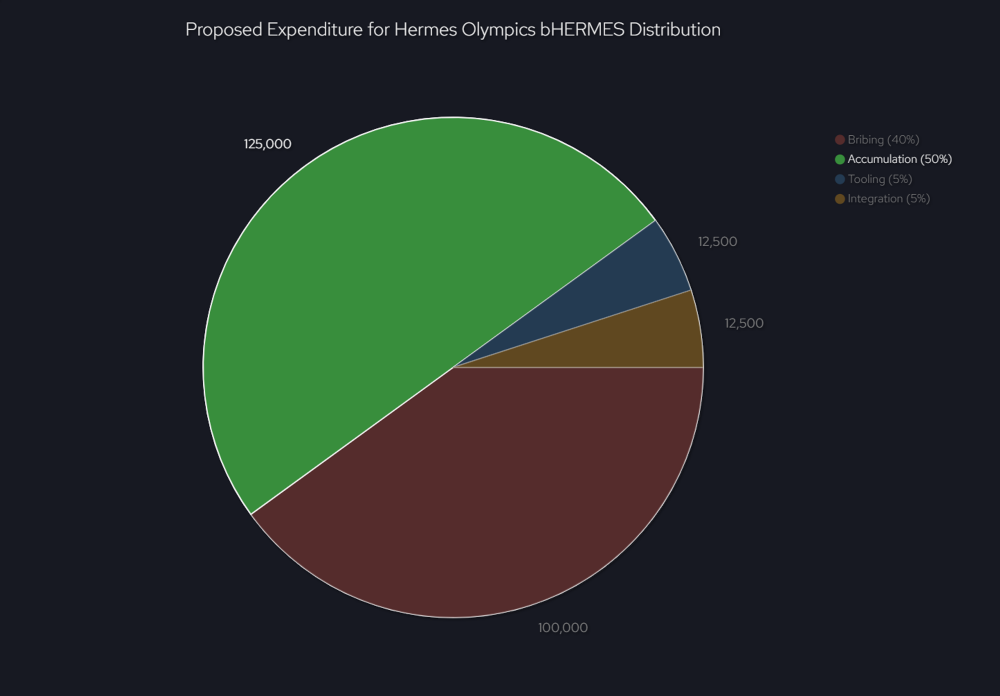
This structured timeline also provides us with time to evaluate the effectiveness of current allocations and making data-driven decisions for future distributions. This ensures that resources are being utilized in a manner that aligns with the evolving goals and priorities of the Maia DAO ecosystem.
💡 The seasonal approach allows Maia DAO Ecosystem and Hermes Protocol to adapt to changing conditions, market dynamics, and community needs.
V. Implementation Plan
A. Proposal Refinement
The 'Accumulating' Sport proposal will be subject to community discourse and feedback, with all pertinent insights integrated into the final version.
B. Hermes Games Integration
The 'Accumulating' Sport will be seamlessly incorporated into the Hermes Games platform, complemented by a user-friendly interface for community exploration and voting.
VI. Governance Considerations
A. Transparent Voting Framework
All governance decisions pertinent to the 'Accumulating' Sport will adhere to our decentralized decision-making paradigm, ensuring unwavering transparency and security. This mechanism will facilitate community-driven amendments, allowing the sport to evolve in response to emerging needs and dynamics.
VII. Community Engagement and Support
A. Educational Endeavors
We will spearhead educational campaigns to enlighten the community about the 'Accumulating' Sport. Regular updates, leader-boards, and data on emerging contenders will be disseminated, equipping community members with the insights needed for informed voting.
VIII. Next Steps and Decision-making Process
A. Proposal Endorsement
Upon securing community consensus, the proposal will be ratified, confirming the bHERMES token allocation for the 'Accumulating' Sport for Hermes Games.
IX. Conclusion
We are confident that the 'Accumulating' Sport will be a transformative addition to the Hermes Games, fostering collaboration, innovation, and integrity. As a Decentralized Autonomous Organization (DAO), we solicit the community's active engagement to ensure this initiative's success.
This conversation was started on Commonwealth. Any attached images have been removed. See more discussion: here
Off-Chain Vote
Yay
2.45M veHERMES100%
Nay
0 veHERMES0%
Timeline
Dec 08, 2023Proposal created
Dec 08, 2023Proposal vote started
Dec 11, 2023Proposal vote ended
Aug 11, 2025Proposal updated