[HIP-4] - V2 Ecosystem Partnership Program Proposal
Proposal Motivation
Our DeFi protocol aims to create mutually beneficial partnerships within the omnichain environment, focusing on capital efficiency and liquidity optimization. We prioritize rewarding active users and providing guidance to DeFi newcomers. Our campaign targets other protocols, DAOs, and strategic stakeholders seeking bootstrap liquidity. To maintain our competitive edge and long-term sustainability, we employ a data-driven approach to emissions allocation, which enables us to assess the allocation of our treasury bHermes position for establishing new partnerships and more.
Leveraging our tokenomics and Uni v3, we expect a significant increase in capital efficiency and reduced liquidity renting costs.
Our commitment to partnerships, capital efficiency, and liquidity optimization puts us in an ideal position to drive adoption towards our omnichain environment and foster long-lasting relationships that benefit the entire ecosystem.
Proposal Overview
- Option 1: Yay, accept proposal as is.
- Option 2: Nay, this proposal needs further discussion.
The main goal of this proposal is to initiate discussion about the features of our Partnerships Program. We seek community feedback on key aspects, such as relevant metrics for a partnership, the allocation of $bHERMES budget for this purpose, and the share of weekly emissions dedicated to each partner.
Examples of relevant metrics include market cap, TVL, age, active users (in-app and communication channels), revenue, bribe capacity, and the number of chains a project is deployed or planning to deploy on in the near future. These aspects help us gauge a project's success potential as we establish partnerships.
Further proposals to downgrade or upgrade the partnership level (combination of grant tier and share of emissions) can be made to align every party with their vision and efforts.
Proposed Budget
-
30M $bHERMES to be permanently locked out of circulating supply in partner bHermes contracts.
-
5% of weekly emissions to be directed to existing partner’s bHermes contracts.
-
After 3 months, 2% of weekly emissions to be added to the initial 30M $bHERMES for new protocols to join in the future.
Partner Program Specifications
The partnership formation process will be multiphasic, with constant monitoring from DAO members. The array of relevant metrics to be observed may change as the community delves deeper into the discussion on these matters.
The primary purpose of establishing new partnerships is to create mutually beneficial relationships between Hermes and the proposed partners.
Benefits of Partnering with Hermes
-
A $bHERMES grant: To accommodate multiple partnerships and optimize the use of limited resources, grant participants will be assorted into five tiers with bHermes grants ranging from 50k to 1m tokens. Partners upgrading their tier will receive the extra $bHERMES resulting from the upgrade.
-
Weekly emissions allocation: Up to 30% of weekly emissions can be dedicated to the partner program. Partners will be granted $bHERMES, allowing them to vote and boost their protocol's products pools or strategies.
Performance-based Reward Distribution
To further ensure that partners fulfill their commitments and make their contributions as agreed, the partner emissions will be distributed based on a performance-based schedule. Instead of receiving partner emissions continuously, partners will receive their allocated emissions at the end of predefined periods, such as every month, every 2 months, or every 3 months.
The partners will be required to meet the set criteria during these periods to be eligible for receiving the partner emissions. The DAO and the community can monitor and evaluate the partners' performance based on the transparent framework and milestones provided by the partners.
If a partner fails to meet their set criteria during the predefined period, any member of the community can initiate a proposal to withhold the partner emissions for that period. This approach ensures that only those partners that actively contribute to the ecosystem and meet their commitments will be rewarded with partner emissions.
How it Works
Partner $bHERMES tokens are deposited in a utility wrapper ERC-4626, which enables easy reception and sharing of $bHERMES in exchange for the ability to transfer these tokens. Although partner $bHERMES is nontransferable, it allows for the use and delegation of it's underlying utility tokens.
A set percentage of weekly emissions, ranging from 0.25% to 5%, can be dedicated to each partner from the emissions allocated to the partners program. These $HERMES emissions will be burned and sent as $bHERMES to reward partners.
The community will consistently review partnerships through in-depth discussions on the governance forums, maintaining transparency.
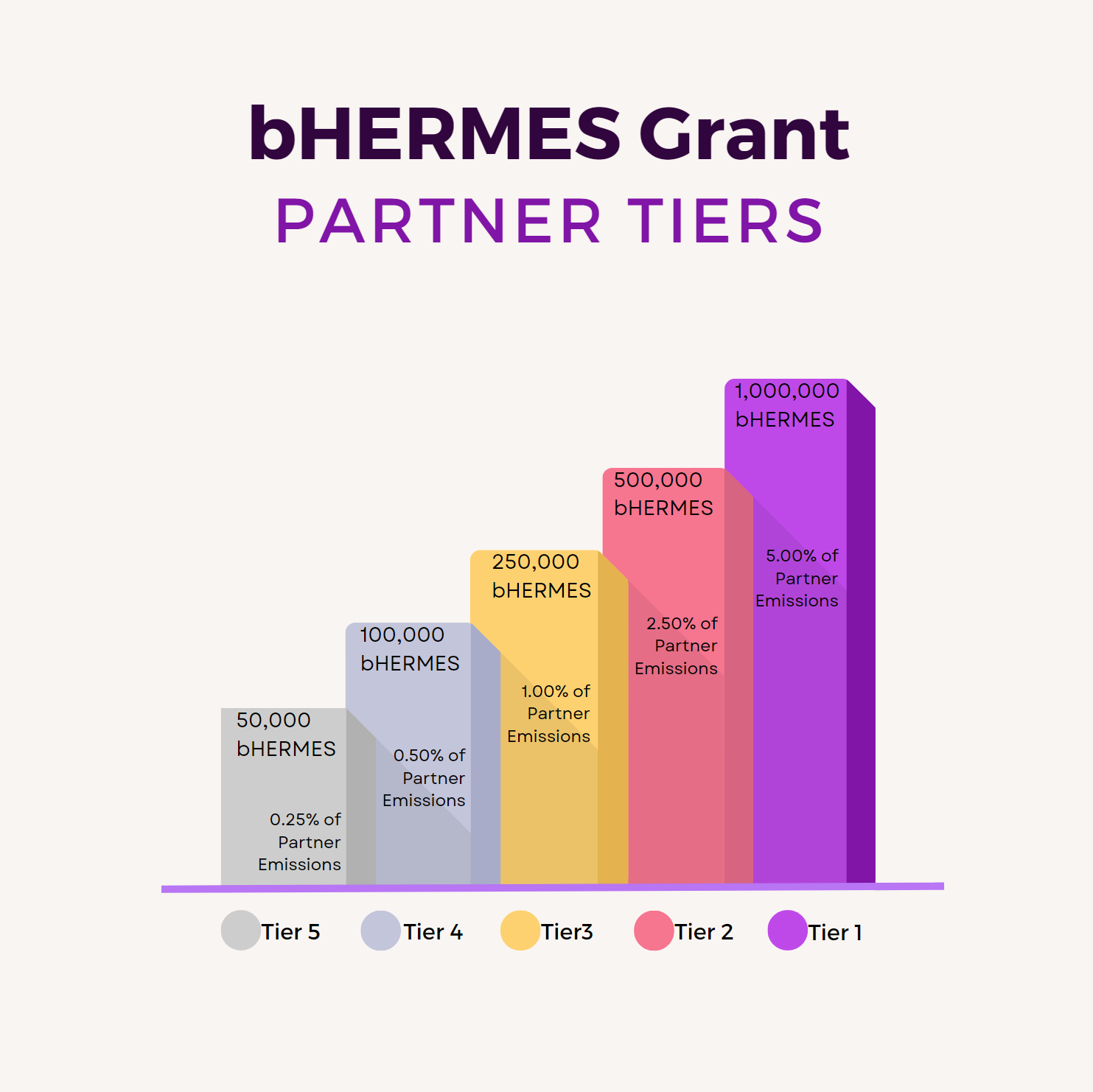
Partner Expectations
Partners should contribute to the ecosystem in various ways, such as leveraging the $bHERMES grant to lower their initial cost for renting liquidity, fostering a healthier ecosystem and encouraging growth. Some suggestions for partners' contributions include:
- Actively bribing to attract more liquidity
- Accumulating or aggregating boost to enhance their protocol's products
- Engaging in other ecosystem-positive activities that contribute to the overall success of the partnership
It's important to note that these are merely suggestions, and partners are not limited to these activities. Anyone can initiate the Partner On-boarding Proposal process to showcase how they would contribute to the ecosystem and propose their value addition to the DAO.
It's essential that partners provide a clear and transparent method for the community and DAO to verify if they are indeed delivering the expected value offers they initially proposed. This can be achieved by setting up measurable milestones, regular progress reports, or integrating third-party auditing tools. By establishing a transparent framework, partners can demonstrate their commitment to the ecosystem, and the DAO can efficiently evaluate the success and impact of the partnership.
Furthermore, anyone can start a Partner Update Proposal to upgrade or downgrade an existing partner status. Removing the partner status would be a way to stop a partner from receiving partner emissions. This proposal should show the journey of the existing partnership, such as original goals and how they were met, as well as the proposed update.
Partner On-boarding Proposal (POP) Process
To help our community and partner’s communities better position themselves to finish this process until V2 launch, partner on-boarding prior to V2 will only consist of Phase 1 and Phase 2. Because of that, Phase 2 will need to include the information that would be included in the on-chain proposal, like requested actions, that would be included in Phase 3.
Phase 1: Request for Comment (POP-RFC)
Timeframe: Minimum 3 days
Form: Governance Forum Post
The first phase of the governance process is meant to allow the community to digest a proposal, comment, and ask questions about the new partner in question and how it will benefit the ecosystem.
In their proposal, the partner should clearly specify the desired tier they are applying for and provide detailed, verifiable information on how they plan to meet the associated requirements. They must also outline a transparent framework that allows any community member to easily track and evaluate their progress towards achieving the milestones set by the partner. This framework should include measurable objectives and verifiable data sources.
To post a RFC, label your post “POP-RFC - [Your Title Here]”. Prior to moving to Phase 2, give the community at least 3 days to read and comment on the RFC. Please respond to questions in the comments, and take feedback into account in the next iteration of the proposal posted in Phase 2.
Phase 2: Temperature Check (POP-TC)
Timeframe: 5 days
Quorum: 10M bHERMES
Form: Snapshot poll
The purpose of the Temperature Check is to signal community sentiment on the new partner on-boarding proposal prior to moving towards an on-chain vote.
To create a Temperature Check:
-
Incorporate the community feedback from the RFC phase into the proposal.
-
Create and post this version of the proposal in the Governance Forum with the following title “POP-TC - [Your Title Here]”. Include a link to the POP-RFC post. You will update the post to include a link to the Snapshot poll after you’ve posted that.
-
Create a Snapshot poll. The voting options should consist of those which have gained support in the POP-RFC Phase. This poll can be either binary or multiple choice but must include a “Nay” option. Set the poll duration to 5 days. Include a link to the Forum Partnering On-boarding Proposal Temperature Check post.
-
Update the Forum post with a link to the Snapshot Poll.
At the end of 5 days, the option with the majority of votes wins. There must be at least 10M bHERMES yes votes to move onto Phase 3. If the “Nay” option wins, the proposal will not move onto the Phase 3.
Until V2 launch that will have full on-chain governance, proposals that pass Phase 2 don’t need to continue to Phase 3. They are considered passed and will be executed when migrating from V1 to V2.
Phase 3: Governance Proposal
Timeframe: 2 day waiting period, 7 day voting period
Proposal creation threshold: 2.5M bHERMES
Quorum: 12.5M bHERMES
Form: [TBD]
Phase 3 is the final step of the governance process. If this vote passes, then a change will be enacted on-chain.
To create an on-chain Governance Proposal:
-
Incorporate any last iterations to your proposal based on feedback prior to posting.
-
Create a topic in the [TBD] titled “POP - Governance Proposal — [Your Title Here]” and link to previous forum posts and the Partnering On-boarding Proposal Temperature Check Snapshot poll.
-
Create your proposal. This can be done either through an interface (on [TBD]) or through writing the calldata for more complicated proposal logic. This calldata will be executed if and when the proposal passes. If writing the calldata yourself, please review the logic with a qualified Hermes community member prior to posting the proposal.
-
Ensure that at least 2.5 million bHERMES is delegated to your address in order to submit a proposal, or find a delegate who has enough delegated bHERMES to meet the proposal threshold to propose on your behalf.
-
Once the proposal has been submitted (or the propose() function has been called), a two day voting delay will start. After the voting delay is finished, a seven day voting period begins. If the proposal passes successfully, the proposed code is executed.
Proposal Structure
This is a suggested process for developing and advancing Hermes Governance Proposals. We are going to create a github repo to serve as a living document intended to be owned, modified and enforced by the Hermes community.
-
Title: [Enter Proposal Title]
-
Author(s): [enter name(s) of associated authors]
-
Related Discussions: [paste link here]
-
Submission Date: [Enter Date]
Body Paragraphs:
-
Simple Summary: Give us a TL;DR on your proposal; no more than 2-3 sentences.
-
Abstract: Introduce and expand on the proposal. Highlight key points on how the proposal will improve stakeholder/tokenholder experience, protocol performance, and the overall implementation process.
-
Motivation: What problems will this proposal address/solve? What’s the value-add?
-
Specification & Rationale: Go all-out and explain the rationale & vision for the proposal! How will this affect the protocol both technically, socially, financially (if applicable), and governance-wise?
-
Benefits (Pros): Provide benefits as to how the proposal implementation will advance the protocol.
-
Downside (Cons): Are there any disadvantages with implementing the proposal?
-
Voting: Define what a “yes” and “no” vote entails. If there are any Snapshot votes or forum polls associated with this proposal, please attach it.
Off-Chain Vote
Yay
1.78M veHERMES100%
Nay
0 veHERMES0%
Timeline
May 01, 2023Proposal created
May 01, 2023Proposal vote started
May 04, 2023Proposal vote ended
Aug 11, 2025Proposal updated