[ARBITRUM] [Non-Constitutional] - Subsidy Fund Proposal from the ADPC
[Non-Constitutional] - Subsidy Fund Proposal from the ADPC
Disclaimer: a small % buffer has been inserted so as to ensure that we are able to OTC $2.5m worth of ARB. Remaining ARB will be sent back to the ArbitrumDAO Treasury.
Executive Summary
As voted on in the ADPC proposal here, one of the key tasks of the ADPC was to conceptualize and structure a subsidy fund for the Arbitrum DAO. As per the proposal passed on 25-Apr-24, the Arbitrum DAO will fund 1 cohort of 8 weeks (2 months) for a total fund size of $2.5 million worth of ARB.
Following the rejection of this proposal which sought to set up a Sub-Committee for the Security Services Subsidy Fund based on community feedback received, the Arbitrum DAO Procurement Committee (hereinafter referred to as the ‘ADPC’) will be responsible for facilitating the selection of projects that will benefit from the whitelisted security audit service providers selected via the ADPC’s procurement framework, as originally proposed in the Subsidy Fund Proposal.
Proposal Request
We propose the creation of a procurement subsidy fund allocating up to $2.5 million worth of ARB to provide financial assistance to both new and existing projects within the Arbitrum ecosystem.
These subsidies will be exclusive to a pre-approved whitelisted set of security audit service providers, selected by the ADPC, who will publicly display their fees. This approach eliminates the need for the ADPC to assess the reasonableness of funds requests.
The aim of the subsidy fund is to incentivise participation and growth among smaller projects helping them to overcome barriers to entry, such as challenges to acquire funding to pay for the cost of robust security audits.
A benchmarking exercise was conducted with various security audit service providers, with this form being shared with 10 service providers (including the likes of Spearbit, Halborn, Nethermind, Three Sigma, Guardian, Zellic, etc.) on their scope of services and fees associated. Based on this, we have estimated that each project will require a 2-month security audit at an average cost of $200K. This will enable the ADPC to potentially fund up to 12 projects; however, it should be noted that the average of $200K is an estimate and fees are usually specific to each project, each project requires a scoping exercise, and audit costs will vary based on the size of the codebase, complexity, etc.
Subsidy Fund Design & Approach
Exec View
· Up to $2.5 million worth of ARB allocated to spend on whitelisted security audit service providers, with an average amount of $200K worth of ARB allocated per project and a max cap of $250K per project (10% of the subsidy fund available).
· ADPC will be responsible for selection and oversight.
· The Subsidy Fund will be distributed across 1 cohort of 8 weeks.
Key Pillars
(A) Subsidy Fund Principles and Criteria
Core Principles Underlying the ADPC Subsidy Fund
Before considering a subsidy application, applicants should carefully evaluate the need for support. The purpose of these guidelines is to clarify the subsidy program and make the process as straightforward as possible.
All applicants should keep in mind the following key principles:
1. Transparency & integrity - Applicants must disclose any potential conflicts of interest and receipt of any prior funding.
2. Encouragement of investment - Subsidies should incentivise investment that would not otherwise occur without the subsidy. They should not cover costs that the beneficiary would have funded independently in the absence of any subsidy.
3. Proportionate and necessary - Subsidies should be proportionate to their intended objective and limited to what is necessary to achieve it.
4. Economic neutrality - The requested subsidy amount should not confer an economic advantage. It should be provided on fair terms, comparable to what could reasonably be obtained on the market.
5. Consideration of funding options - Applicants are expected to explore all available funding options and responsibly choose the option that best suits their needs.
6. Enhancement of beneficiary security - Subsidies should bring about changes that enhance the security of the beneficiary’s protocol.
7. Positive impact on the Arbitrum ecosystem - Subsidies should have a beneficial effect on the Arbitrum ecosystem, contributing to its growth and sustainability.
8. Value for Money - The evaluation method should ensure decisions maximize both financial and non-financial value to Arbitrum.
9. Probity - Subsidies should be issued in an environment that ensures fairness, impartiality, and compliance with established guidelines and rules. There will be an emphasis on transparency, accountability, and integrity throughout the procurement process, evidenced by the development of this publicly documented Means Test methodology. This focus on Probity will mitigate procurement risks and safeguard the integrity of the procurement process.
10. Risk Management - Risk management policies will be implemented to identify and mitigate procurement risks.
11. Engagement with SMEs - We have invited a wide range of organisations to participate, all of whom will be subject to the eligibility criteria.
12. Cyclical Whitelist events - We will have clear rules for cyclical whitelist reviews to open a pathway for future applicants and new market entrants.
Means Test: Criteria for Evaluation
The reason for this approach over a purely quantitative approach is that most projects, especially the smaller ones being targeted within this subsidy program do not possess obvious immediately measurable metrics.
The development of this Means Test aims to provide a structured approach for the ADPC to evaluate applications for financial assistance. This tool is designed to identify applicants who would benefit most from support, ensuring equitable access to subsidies within the Arbitrum Ecosystem, particularly for smaller entities with valuable contributions.
The intent is to allocate subsidies to those most in need, avoiding exploitation by larger players looking for a ‘free lunch/handout’. Such an event could give recipients an unfair advantage over their competitors or be an inefficient use of the DAO’s funds if they do not bring about a net positive change.
The means test will include a scoring system ranging from 1 to 5, reflecting the merit of each application.
· Rating 1: Unsatisfactory
· Rating 2: Below expectations
· Rating 3: Meets expectations
· Rating 4: Above expectations
· Rating 5: Exceptional
Each of the sub-criteria in the means test have varying levels of importance, and they will each have a weighting attached. A weighting of 1 indicates low importance, 2 indicates neutral importance, and 3 indicates high importance.
Each application will be scored by ADPC members, followed by a collective decision on the most deserving grant recipients, taking into account the rating against the eligibility criteria, a value-for-money evaluation and the funds available.
After the applications have been reviewed and decisions taken as to the grant beneficiaries, the average score assigned to each project will be shared publicly, ensuring that transparency is maintained throughout the process. In the event that an applicant receives a high score but is not chosen as a grant recipient, explanatory feedback will be provided either on an individual or collective basis to the cohort.
EVALUATION CRITERIA
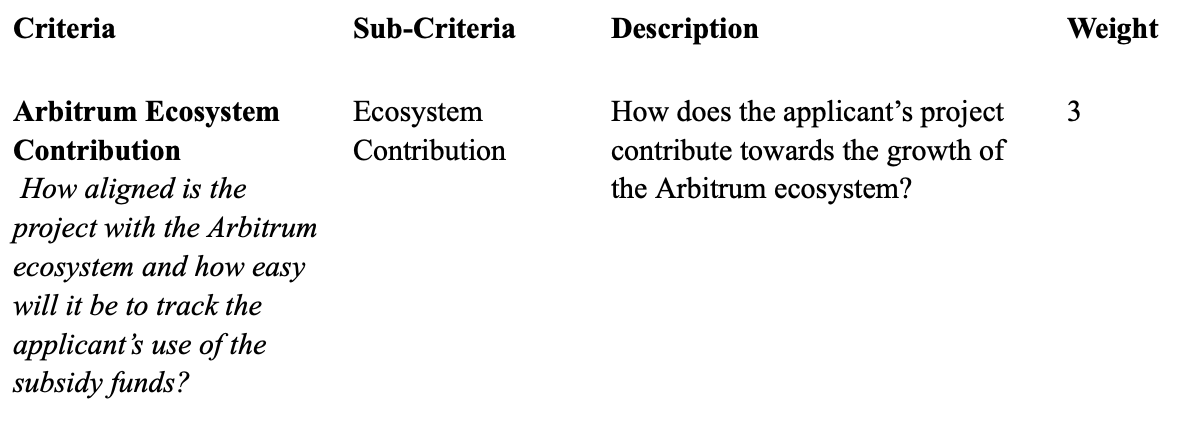
<img height="700" width="682" src="https://static.tally.xyz/12e204ca-2317-406e-a985-f3155a61f1
... please visit link below to view full proposal
Off-Chain Vote
For
29 HVAXVC100%
Against
0 HVAXVC0%
Abstain
0 HVAXVC0%
Timeline
Jul 04, 2024Proposal created
Jul 07, 2024Proposal vote started
Jul 20, 2024Proposal vote ended
May 12, 2026Proposal updated