[COMPOUND] Delegate Compensation Program Pilot
Delegate Compensation Program Pilot
Delegate Compensation Program Pilot
Authors: AranaDigital, PGov, StableLab
Summary
This proposal introduces a Delegate Compensation Program to incentivize active participation, enhance accountability, and support sustainable governance. Delegates are essential to Compound’s governance, but the lack of compensation impacts participation and retention. We propose a structured program to ensure fairness, transparency, and high-quality contributions, run over the course of the coming 6 months. If this proposal passes, the Compound Governance Working Group (CGWG) will immediately begin administering this program as per the below specifications (see “Detailed Specification”). Selection of this initial cohort of delegates will follow a delegate score that aggregates delegate participation data over the past 6 months, incorporating voting %, vote timing, and impact on new collateral TVL growth.
- Overall Budget: $288k
- Duration of Pilot Program: 6 Months
- Total Delegates Selected: 16 (divided into 2 tiers, with 8 per tier)
Final forum post can be found here.
The initial discourse if linked here.
Background
Governance in Compound has been live since 2020, and the protocol has grown considerably over the past couple of years, now reaching a TVL of over $4B. There have been 375 proposals so far, and as the protocol grows, there are more proposals per month than before.
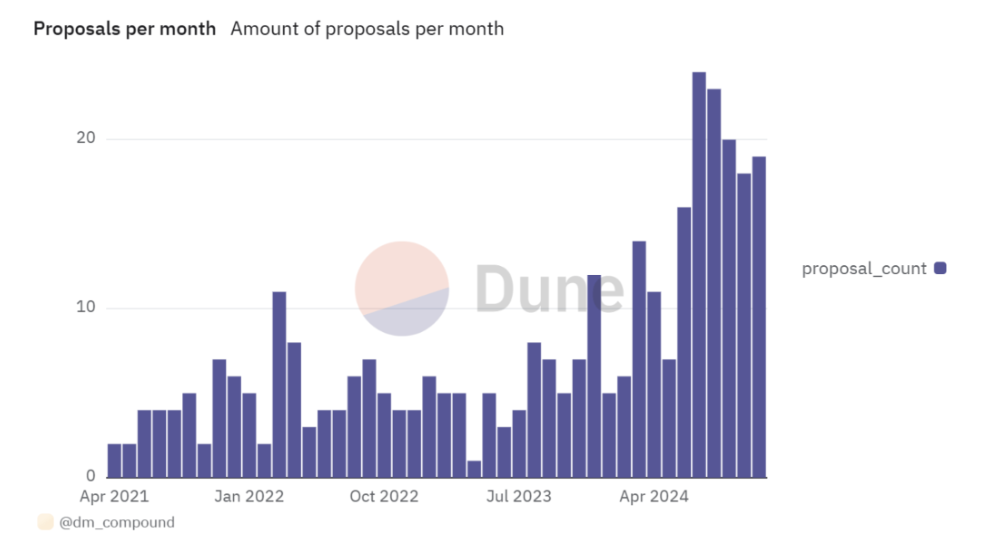
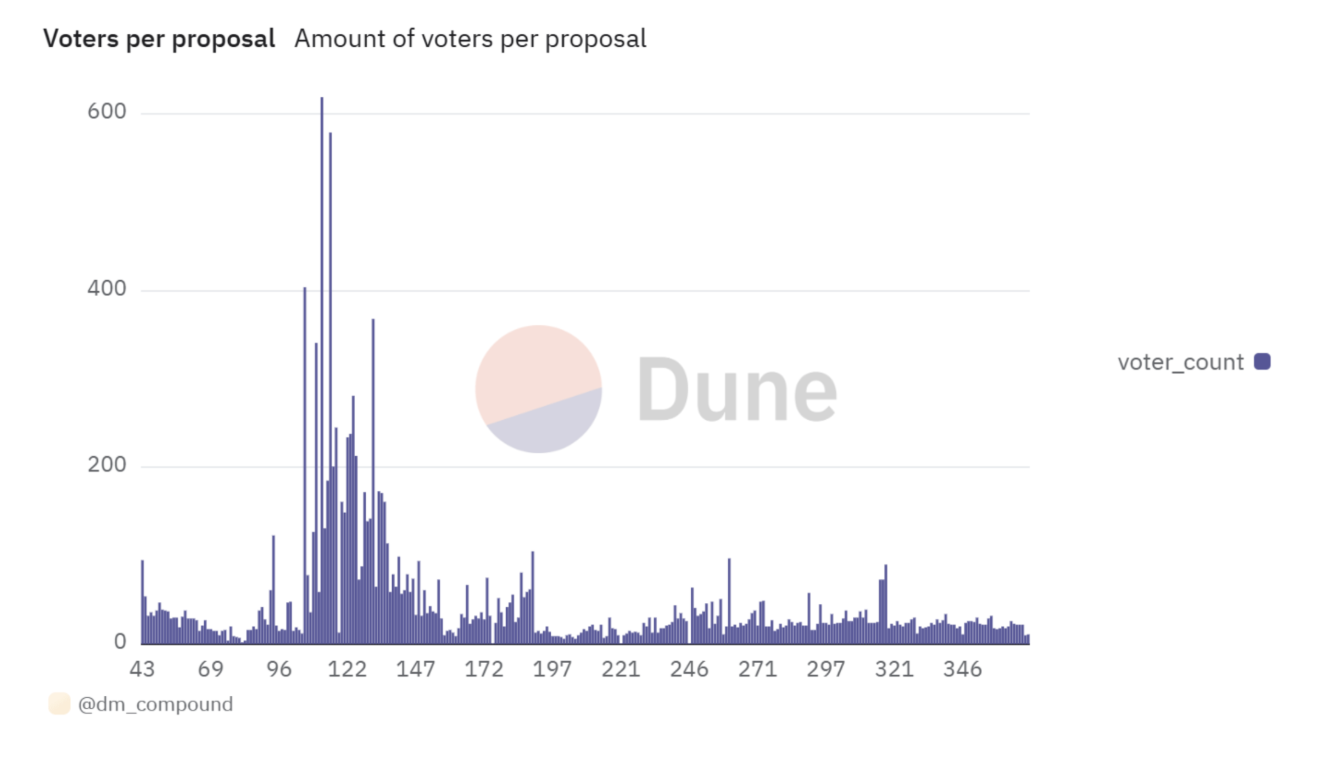
However, the number of voters has been decreasing, despite their importance, likely due to the absence of a financial incentive.
 Compensation Philosophy
Effective governance within a DAO demands engaged, well-informed delegates who diligently track ecosystem developments, analyze proposals, and participate in governance decisions with both expertise and integrity. However, the absence of compensation places a significant financial and operational burden on delegates, forcing them to limit their engagement, resulting in uninformed or sporadic participation. A significant consequence of such complacency is governance attacks, such as the one faced by Compound in Q3 2024.
To address these challenges, this compensation program is designed to align delegate incentives with Compound’s overarching goals, ensuring that their contributions directly advance the protocol’s long-term success. By rewarding behaviors such as thorough proposal evaluation, consistent voting participation, and meaningful engagement with the community, the program fosters a culture of diligence, responsibility, and strategic decision-making.
Community feedback will play a central role in shaping and refining these incentives to ensure they remain aligned with the DAO’s evolving priorities and values. By running a pilot, this program not only provides immediate benefits in enhancing governance participation but also establishes a scalable framework that can evolve alongside Compound’s governance needs. Data collected after the end of the 6 month period will be important for amending and refining future compensation cycles.
Ultimately, in an increasingly adversarial landscape, where well-capitalized entities can exploit governance vulnerabilities—often due to delegate complacency and voter apathy—underfunded governance participation poses a significant risk. Without proper compensation, DAOs become susceptible to governance attacks, inefficient decision-making, and weakened resilience against extractive proposals.
Delegate Compensation Programs Across DAOs
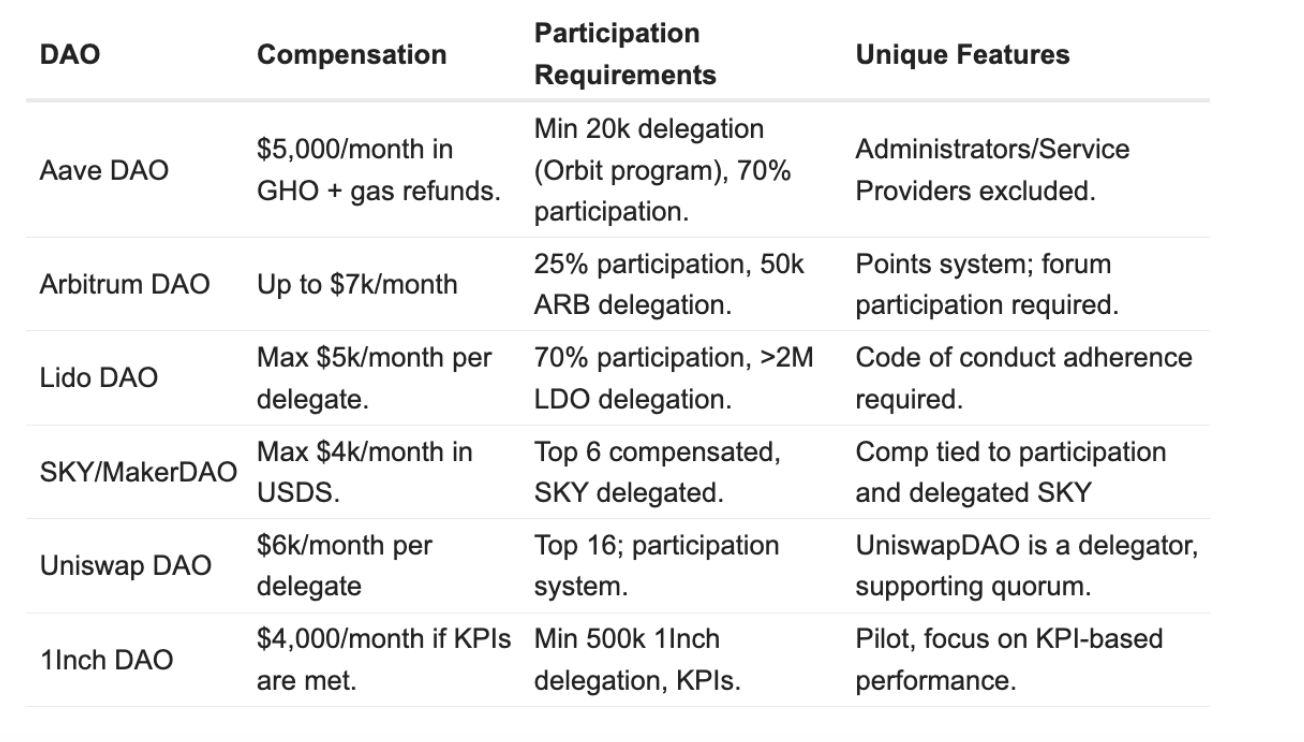 The program we are proposing aligns Compound with high-performing DAOs while allowing the CGWG to adapt incentives to meet the protocol’s unique needs. A key feature incorporated in this pilot program is the delegate score, which aggregates various factors, including TVL-based impact as a result of a delegate's voting decision.
Detailed Specification
The compensation program will run over the six months. With a budget at $288k, the pilot will be allocating $48k/month, which will allow Compound DAO to evaluate key metrics, including delegate engagement, governance outcomes, and community feedback. These insights will be critical in assessing the program’s effectiveness and identifying areas for improvement.
The CGWG will oversee program implementation and rewards distribution. Funds from the passing of this onchain vote will be sent to the working group’s multisig (0xfd947c72f09703210eeCbcab9c9206fE5e1Bb6e2). All distributions will be paid to program participants in the form of COMP tokens after the conclusion of each month.
Two different groups of criteria will determine how a delegate may be admitted to the pilot program vs the compensation attained while partaking in the program.
Part A: Selection Criteria
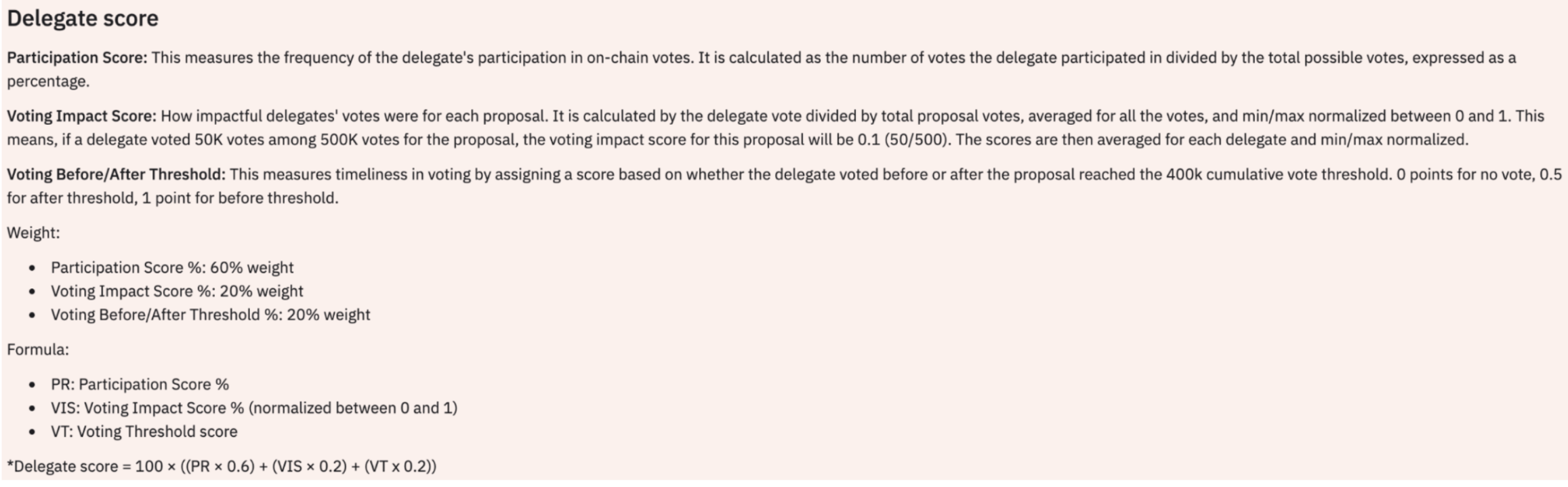
For admittance into the pilot program, the below delegate score over the trailing 6-month period will be utilized:
 You may view the up-to-date delegate rankings here.
One of the predominant pieces of feedback we received when designing this initiative was to not heavily bias the score towards delegates with large amounts of voting power. This can act as a double-edged sword, where large delegates in theory should be rewarded for their proportional contribution to meeting quorum and thereby prompting the further increase of protocol TVL, for example. To address this concern, the voting impact score, which is a function of a delegate’s voting power, remains capped at 20% of the total delegate score.
We also decided to keep the voting impact score present in the calculation since tangible influence on protocol metrics like collateral TVL was an additional concern posed by delegates, where voters should be rewarded for increasing protocol growth in a more objective manner. For the pilot program, we will solely use delegates’ impact on TVL for new markets/collaterals as the primary metric—this may change in future iterations of the program. Impact-weighted scores are scarcely used by DAOs today for paying delegates, and they inherently contain a bias towards those with more voting power since more VP means higher impact on the passing of a proposal. KPI-driven compensation is something that DAOs should start trending towards, at least to a degree, hence why we are including this metric.
In accordance with compensation programs instituted by other DAOs, we’ve kept the primary weight on the delegate’s participation score—retaining that at 60% of the total score. We strongly believe that this weight should account for at least 50% of any compensation program since high rates of participation directly dictate how well a governance system is working.
Delegates for this pilot will be selected solely based on their delegate score and will be divided into two tiers. The top 8 entities with the highest score—that apply to the program—will fall under Tier 1, and the following 8 will fall under Tier 2. Relative to other protocol DAOs, this program is indexing on not only rewarding larger, active delegates but also attracting a new cohort of voters.
If the proposal to pursue this program passes, we will be releasing a forum post that’ll act as the venue to submit your application. Just because a delegate has a high score does not mean they will be automatically inducted into the program; everyone must apply. A 7-day period will be granted for everyone to submit their applications, which will ask for basic details about the applicant and prompt them to set up a delegate communication page to articulate their voting rationales. To reiterate, admittance into the compensation program will be solely based on your delegate score, and the top 16 applicants will be eligible for this program.
Part B: Compensation Breakdown
Monthly compensation will be divided into two payment types: base and bonus rate. Base rate is the amount a delegate admitted into the program will receive for voting on onchain votes. The bonus rate is the amount a delegate will receive for posting rationales regarding their voting decision on their respective delegate platform.
Tier 1
- Monthly Base Rate: $3000 in $COMP
- Monthly Bonus Rate: $1500 in $COMP
TOTAL = $4.5k*8 delegates = $36k/month
Tier 2
- Monthly Base Rate: $1000 in $COMP
- Monthly Bonus Rate: $500 in $COMP
TOTAL = $1.5k*8 delegates= $12k/month
Monthl
... please visit link below to view full proposal
Off-Chain Vote
Timeline
Feb 23, 2025Proposal created
Feb 23, 2025Proposal vote started
Feb 26, 2025Proposal vote ended
May 12, 2026Proposal updated