Who should be able to write proposals?
Our mission is to be the most community-led yield farm in the Polygon/Matic ecosystem. Part of that is engaging our community in all the big steps along the way, and the first governance vote is a very big step. The team at PolyVertex has opened a vote regarding who can make proposals in our new governance system. Anyone can vote on these proposals by using their voting power in VERT or VERT LP's, but who makes those proposals is up for vote right here, right now.
This vote could be the most IMPORTANT event, a cornerstone in the history of PolyVertex and the future of the VERT token. Please take into careful consideration the pros and cons of the two options found in this proposal: 1) allowing ANYONE to make proposals with enough VERT or 2) allowing ONLY nominated/elected and qualified delegates to make proposals.
Allowing anyone to make proposals with enough VERT is simple, arrives at more unhinged diverse suggestions, and seems more in alignment with our vision on the surface. A delegate system is clearer, more serious, has less potential for mob rule, and cannot degrade into a plutocracy (ruling by the wealthy class). The delegate system attempts to fix some issues with the proposal threshold but will make it more complex and dependent on volunteers.
Crocodile Arms made a video that breaks down the pros and cons of each choice. Click on the image below to watch it on YouTube:
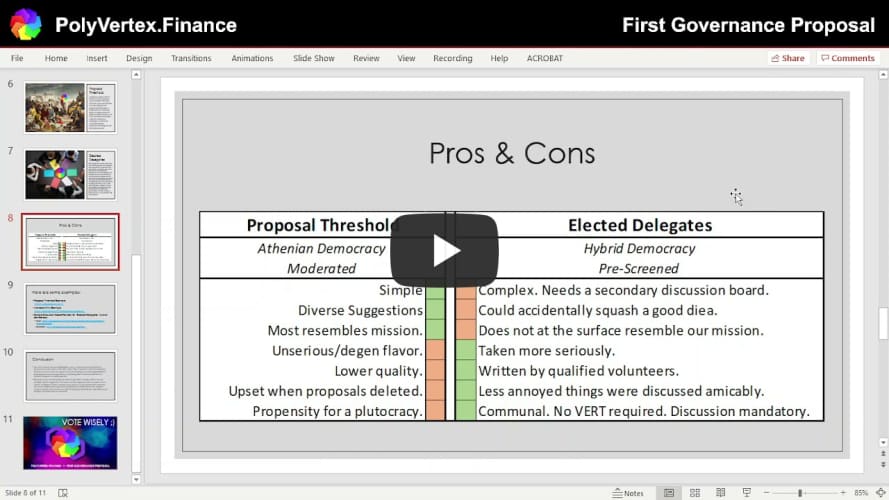
Choice #1 - Anyone With Enough VERT
The "Proposal Threshold" Method
A minimum number of VERT is required to create a proposal, such as 250 VERT. That would mean that anyone with 250 VERT can make a proposal. The proposal would be subject to interpretation and community bylaws. The bylaws dictate if a proposal could be discarded, such as if it was either unreasonable, suspected of chicanery / shenanigans, or didn't meet quorum (participation minimums). These proposals will be heavily moderated.
PROS:
- Simple. No secondary systems for proposal requests have to be present.
- Diversity. Due to the plethora of possible voters, a diverse number of suggestions could be made.
- Democracy. Most resembles the mission: to be the most community-led yield farm on the Polygon network.
CONS:
- There could be a sea of unserious votes. It could cause confusion before they can be moderated away or make it look like we're not a serious project.
- Some people will be pissed their favorite proposals were rejected, and the feeling of having your proposal turned down after the fact weighs heavier than the feeling of having the proposal turned down in the discussion phase. Mob mentality may ensue and worsen the state of the matter.
- The low quality of the proposals could create misinterpretation at a higher rate than if a qualified delegate did it. Moderators may be tempted to remove and repost these themselves, which likely will affect the outcome.
- The threshold can create an elitist plutocracy of whales or mini-whales, since the only way to programmatically increase the quality of proposals is to up the threshold.
Choice #2 - Only Elected Volunteers
The "Elected Delegates" Method
Only designated unpaid volunteers can create proposals, the delegates, who will gather and prescreen all requests in a secondary discussion board, then craft proposals. Nominations for new delegates can be taken via the discussion board, and their election will be held on the governance platform. Nominees must pass certain qualifications in the application process (determined by the governance) such as well written/spoken, unlikely to abuse power, likely to interpret requests accurately, and understands prerequisites. Periodic voting to keep, remove, or add positions will be scheduled.
PROS:
- Clearer. The clarity of the proposals will, on average, be much higher than if anyone could make a proposal.
- Serious. There will be virtually no proposals of an unserious or malicious nature.
- Amicable. Less people will get upset if their favorite proposal request never made it past screening than if it was rejected after the vote. Mob mentality crisis averted, hopefully.
- Communal. In fact is less elitist, since you don't have to be a whale or miniwhale to write a proposal. You can have zero VERT to be elected. Discussion is mandatory before a proposal is ever written.
CONS:
- Complex. A secondary discussion board is required to take suggestions and get feedback on proposals.
- Potentially less suggestions will make it to proposals, which means less diverse ideas. PolyVertex could miss out on lucrative niche opportunities.
- Does not, at the surface, resemble "the most community-led yield farm on Polygon" to have delegates writing proposals.
Off-Chain Vote
Anyone With Enough VERT
7.74K 46.5%
Only Elected Volunteers
8.89K 53.5%
Timeline
Aug 23, 2021Proposal created
Aug 23, 2021Proposal vote started
Aug 27, 2021Proposal vote ended
Oct 26, 2023Proposal updated