Deployable custom NFT shop & dashboard for land owners & operators
by 0xea5fed1d0141f14de11249577921b08783d6a360 (GabeDG)
Should the following Tier 4: up to $60,000 USD, 6 months vesting (1 month cliff) grant in the Platform Contributor category be approved?
Abstract
The metaverse is a virtual economy for the exchange of virtual goods & services via wearables, NFTs, etc. For the economy to grow, tools must exist and readily be available to land owners and their teams to efficiently manage on-scene NFT shops.
We observe many brands today getting involved in the metaverse to stay “ahead” in their industries, its positive PR, and extra stream of income. However, with the lack of proper tools to efficiently deploy and monitor its virtual goods, companies may not fully invest in its metaverse sales initiatives.
To solve this, we are motivated to develop the tools required for scene owners in Decentraland to efficiently sell their digital objects on their scene.
Grant size
60,000 USD
Beneficiary address
0x9243C7F89737775413b55DcB3D9237Cb20618a3b
Email address
Description
We are going to develop a npm package for Decentraland that will allow any scene owner to implement their own “on-parcel store” to manage the purchase and sale of any wearable, in a streamlined, efficient way. The objectives for the project are: Each owner should be able to have their own shop displaying the items they choose to sell, on their own scene. Separate the role of a developer from a community manager/ event planner by allowing the community manager to easily manage the published items to the shop from a user-friendly website, without needing to modify the scene code.
The process is the following:
A developer implements this new package on a scene Within the scene code, ‘’slots’’ are created, which are spaces where the wearables will be located, specifying the x,y,z coordinates of these slots. From the external website, the community manager will have the chance to indicate which wearable they would want to place for sale on each of the slots The external website will automatically generate a json file with all of the necessary configuration for that shop. The scene will interface accordingly to the set configuration The users are now allowed to access the scene to purchase the objects (i.e. wearables) placed for sale.
Additionally we will add a functionality to allow the user to publish their wearables to the marketplace from a 2D module window but still from within the metaverse.
Specification
The platform will rely on its own backend, developed over node js. This backend will manage the information of each scene shop and marketplace. The package that will be implemented on each Decentraland scene will be developed using Typescript. There will be a websocket connection between the backend and each scene that implements the package for pushing marketplace updates. The transactions towards the marketplace will implement meta-transactions for a seamless experience (and free gas transaction for the user) .
Personnel
The team will be formed by four senior developers: 0xGabe (PMO) Null (Front end) Tallulah-Arg (Back end) Ngioffre (Front - Back)
The team has expertise on the following areas: Vainilla js, Vue.js, React.js, React native, Ionic, Cordova , Node.js , Nest.js, Php, Bash scripting , Sql and no-sql databases., Infraestructura, AWS services , Gcp services, Github actions, Jenkins CI CD, NX monorepo, Pulumi for CI/CD, Web3, ethers js, Solidity, Hardhat and many more.
Our development team was responsible for the following milestones in Decentraland: Discord chat integration inside Decentraland Twitch chat integration inside Decentraland Theta streaming services integration inside Decentraland Development of vip areas/restricted areas based on the possession of an NFT Development of the Amnesia scene Development of a CMS for Decentraland scenes.
The latest development, the CMS for scenes, is a solution which offers the possibility to manage banners and variables of a DCL scene from an external website.
This is how the dashboard looks like: https://i.postimg.cc/gkfJSZNg/dashboard.jpg
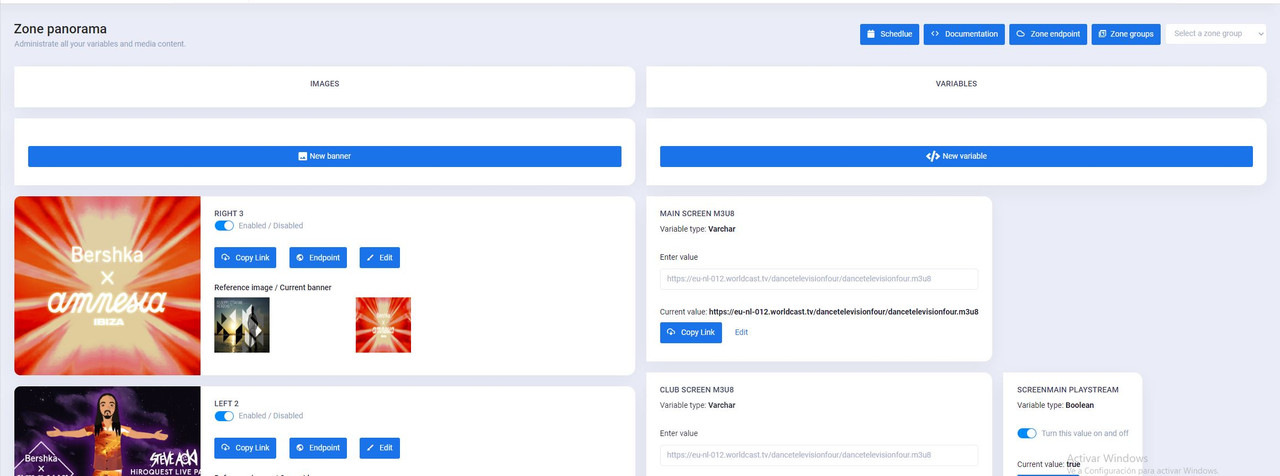
The user is able to modify banners or variables from within a dashboard, and the changes are reflected on a json file, which is obtained through an endpoint. The Decentraland scene uses that endpoint and reacts accordingly to the configuration (i.e., specifying the media an advertising banner should display). This tool allows for a CM to make changes on a scene without the help from a developer.
Roadmap and milestones
If the grant proposal is passed, a completed & tested package would be available at the beginning of Q1 2023. 2D Interface for wearables (sell and purchase) inside the metaverse. AvatarShape integration. Real-time Web3 confirmation to the marketplace. Plug and Play SDK for node.js (Decentraland), full typed. Improve test code-coverage. Design metaverse UI Automatically create slots within the account setup. Ready to use dispenser functionality. Web3 backend integration using an external provider. Sales reporting Centralized backend implementation Build database schema with migrations Deployment and go-live
Off-Chain Vote
yes
5.77M VP87.6%
no
817.23K VP12.4%
Timeline
Sep 15, 2022Proposal created
Sep 15, 2022Proposal vote started
Sep 29, 2022Proposal vote ended
Oct 26, 2023Proposal updated